


other sites
topics
archives
- April 2005
- May 2005
- June 2005
- July 2005
- August 2005
- September 2005
- November 2005
- December 2005
- January 2006
- February 2006
- March 2006
- April 2006
- May 2006
- June 2006
- July 2006
- August 2006
- September 2006
- October 2006
- November 2006
- December 2006
- January 2007
- February 2007
- March 2007
- April 2007
- May 2007
- June 2007
- July 2007
- August 2007
- September 2007
- October 2007
- November 2007
- December 2007
- January 2008
- February 2008
- March 2008
- April 2008
- May 2008
- June 2008
- July 2008
- August 2008
- September 2008
- October 2008
- November 2008
- December 2008
- January 2009
- February 2009
- March 2009
- April 2009
- May 2009
- June 2009
- September 2009
- November 2009
- December 2009
- March 2010
- April 2010
- June 2010
- August 2010
- January 2011
- July 2011
- November 2011
Tuesday, January 15, 2008
Reviews and Love
posted by barsoomcore
We met Stefan in Tokyo -- he was the guy with the biggest collection of videotapes I'd ever seen. He was leaving town and was looking for someone to take his collection away. Me, I volunteered. Numerous large shopping bags full of VHS cassettes were lugged across Shinkoiwa and deposited in our loft. Stefan mentioned a few key ones that were not to be missed and then he was gone and we never saw him again.
We watched a lot of those movies, and they had an immense impact on us. Swordsman II. Bullet In The Head. The Bride With White Hair. Chungking Express.
Classics now, but at the time they were piled up willy-nilly with less memorable titles like Wonder Seven or An Amorous Woman of the Tang Dynasty (you gotta admit, it SOUNDS promising enough). It was hard to push our way through the towering collection without a guide of any sort. A great deal of time was wasted watching absolute crap.
 But then a book appeared. A book that laid out Hong Kong cinema of the 80's and 90's, gave solid reviews of many films and placed them in a context so that we could make sense of what we were watching.
That book was Sex and Zen & A Bullet in the Head. Written by none other than Stefan himself.
That's correct. We inherited the video collection of the author of the definitive book on Hong Kong New Wave cinema. And the impact goes deeper than you know.
First of all, Stefan and his co-writer Mike Wilkins articulate so well in this book the joys of these films:
But it's in the reviews themselves that this book really shines.
"There is a fine line between horror and humour, and Mr. Vampire does everything but jump rope with it."
"Naked Killer arches its back and spits at you for ninety minutes."
We're still in Chapter One, here. This book is full of gems like that.
"Transfer cracked-shell, evil-egghead brains into killer androids, and stuff like this is bound to happen."
Besides providing us with a guide to what have now become a solid set of our favourite films ever, S&Z&aBitH also provided me at least with a form of writing that I don't think I've ever quite shaken -- the smug, knowing summation of dire events that is nonetheless delivered with heartfelt emotion and some spectacular turns of phrase. Take this comment from their review of the rather crappy Wicked City:
"Tragic potential energy becomes tragic kinetic energy, and almost everyone dies."
Come on. That's a pretty sweet little sparkle, right there.
For some reason I've picked this book up recently and am awed all over again by the energy and obvious love it brings to its subject. The Hong Kong New Wave petered out a number of years ago, and we'll never see films like Full Contact or Drunken Master II again, but this book takes me back to what it was like to first discover this whole world of cinema I'd never even heard of.
We watched a lot of those movies, and they had an immense impact on us. Swordsman II. Bullet In The Head. The Bride With White Hair. Chungking Express.
Classics now, but at the time they were piled up willy-nilly with less memorable titles like Wonder Seven or An Amorous Woman of the Tang Dynasty (you gotta admit, it SOUNDS promising enough). It was hard to push our way through the towering collection without a guide of any sort. A great deal of time was wasted watching absolute crap.
But then a book appeared. A book that laid out Hong Kong cinema of the 80's and 90's, gave solid reviews of many films and placed them in a context so that we could make sense of what we were watching.That book was Sex and Zen & A Bullet in the Head. Written by none other than Stefan himself.
That's correct. We inherited the video collection of the author of the definitive book on Hong Kong New Wave cinema. And the impact goes deeper than you know.
First of all, Stefan and his co-writer Mike Wilkins articulate so well in this book the joys of these films:
In describing Hong Kong cinema — its excitement, vitality, electricity — film-school polemics fail. There is no pointy-headed, white-wine-and-baked-brie philosophy that adequately describes its "scalding propulsion," the force that blasts you out of your seat and rearranges your popcorn.
But it's in the reviews themselves that this book really shines.
"There is a fine line between horror and humour, and Mr. Vampire does everything but jump rope with it."
"Naked Killer arches its back and spits at you for ninety minutes."
We're still in Chapter One, here. This book is full of gems like that.
"Transfer cracked-shell, evil-egghead brains into killer androids, and stuff like this is bound to happen."
Besides providing us with a guide to what have now become a solid set of our favourite films ever, S&Z&aBitH also provided me at least with a form of writing that I don't think I've ever quite shaken -- the smug, knowing summation of dire events that is nonetheless delivered with heartfelt emotion and some spectacular turns of phrase. Take this comment from their review of the rather crappy Wicked City:
"Tragic potential energy becomes tragic kinetic energy, and almost everyone dies."
Come on. That's a pretty sweet little sparkle, right there.
For some reason I've picked this book up recently and am awed all over again by the energy and obvious love it brings to its subject. The Hong Kong New Wave petered out a number of years ago, and we'll never see films like Full Contact or Drunken Master II again, but this book takes me back to what it was like to first discover this whole world of cinema I'd never even heard of.

Tuesday, December 04, 2007
Serpent, Winged
posted by barsoomcore

"First, Shaft is a sex machine for ALL the chicks. He didn't fall for no Five-Point Palm Exploding Heart Technique, neither."
IMDB's "Plot Keywords" list does a reasonable job of summing up this odd little picture, including as it does Giant Monster, Human Sacrifice, Decapitation, Female Nudity, Police, Blood, the Chrysler Building New York, Death, and Gore, but strangely there is no mention of either SHAFT or MIME.
See, while it's nominally a monster movie, and indeed several minutes of the film are devoted to a monster devouring assorted New Yorkers, after one hour and fifteen minutes, the audience is suddenly confronted with a MIME. Observe:

That is clearly a MIME in a car with SHAFT.
I know, you're startled. Maybe you didn't expect to see a MIME in a car with SHAFT. I don't blame you. But do not doubt your senses. Here it is again:

Notice how the MIME is ACTUALLY ACTING. He's looking over at SHAFT with that "curious" expression that lets you know the director told him to look curious. I tell you, actors are a rare funny breed.
What lies is that actor telling himself in order to go through with this scene? How is he structuring this in his imagination so that he believes he'll be able to get another part on the basis of this performance? And what is the director thinking? Most likely, I imagine, how he's going to spend the money he just won after betting Richard Roundtree he could get that new kid to dress up as a MIME.
Whoever that MIME is, I sure hope he has this blown up to poster size on his bedroom wall:

Words fail me.
Fortunately, ten minutes after he appears, the MIME vanishes from the script, never to be seen again. His presence is not explained (other than the fact that it's 1982 and Knight Rider is the most popular new show on television. We all share the blame for the 80's).
Perhaps you find it strange I begin a discussion of one of the last true B-grade giant monster movies with several hundred words on the subject of a mime, but it was scarring, I tell you. A man doesn't just walk away from something like that. It haunts him.
 Oh, yeah, there's a monster in this picture. As these things go, it's by no means a terrible monster -- the design isn't much (it kind of resembles a winged prehensile penis), but it kills people bloodily and SCREEEES with gusto.
But really it's all the secondary weirdness that really makes this film. Michael Moriarity's bizarre performance as the cowardly wheelman who confronts the beast in its lair, and David Carradine going "Phew!" everytime they make another narrow escape (I'm not kidding, the guy literally says, "Phew!" like he's reading some 1950's Batman and Robin dialogue), combined with Roundtree's angry cop makes you wonder if all three of these guys think they're in different movies.
Or this guy:

Okay, you might have believed me about the MIME, but I know you're going to doubt me about this, but honestly. This dude pops up into the frame next to the sacrifical victim, looks down at the naked guy he's about to gut and says
Seriously, I'm not kidding about this. He says
God's Honest Truth, here, people. ACTUAL dialogue, here. Not a word of a lie. This dude says
"How are you?"
Man. I thought the dialogue in Live Free or Die Hard was uninspired. Again, what the heck is going through this actor's head? Because you know he's got himself convinced that THIS is the part. He's going to put that on his reel. He'll talk it up at his next audition. I'd love to hear that story.
But that's not all, folks. There's also the blonde doing push-ups:

1982 was a tough year for actors, obviously. That girl's really givin' her, though. You gotta award some points for grit.
Still, even in 1982 actors had their limits. Apparently there was a rumour that a sequel would be made:

Fortunately, it never came to that.
The Ones Nobody Knows: The Bandy Papers
posted by barsoomcore
 I first encountered Bartholomew Bandy, Canadian hero of World War I and all-round dashing figure of the twentieth century, in the mid-eighties. I was reading a lot of military fiction then, and the cover, here, with biplanes and a promise of comedy and a Canadian perspective on the Great War was more than enough to pull me in. I found Three Cheers For Me in a used bookstore, of course, as the books had been out of print for a decade or so when I first got hooked, but I continued to prowl used bookstores across Calgary, searching for further tales of the redoubtable Bandy.
I believe Donald Jack is the man who introduced me to the word "redoubtable", actually. Not to mention "obviate", and probably "spifflicated", too. The over-the-top drinking binge parties Jack describes in these books have always been the standard I've held my own partying up to. Nobody's ever actually fired a handgun at copulating insects at one of our parties, however, so there's room to grow, there.
Interesting that Jack -- a Brit who emigrated to Canada after World War II -- should come to write a series with such a dedicatedly Canadian bent on history. Bandy considered Canadianess at length throughout these books, and while he may be somewhat atypical, there's no doubt he represents some of the fundamental qualities of the Canadian character.
And it's not all that flattering. Bandy is self-righteous, deceitful, annoyingly smug, and lacks the ability to see himself and his own foolishness clearly.
Oh sure, he's courageous enough, when physical danger nears, but he cowers in the face of the powerful and is as enthusiastic a bootlicker as one could imagine. He's quite thoroughly despicable at times.
Hm. Maybe the lack of popularity of these books isn't so hard to explain.
But no. There's thrilling aerial combat, romance, the great sweep of history, and some of the funniest stuff I've ever read in my entire life. It doesn't matter how many times I read the bit where Bandy tries to replace Louise's dress; I'm helpless with giggles every time. These books deserve a vast audience, inside or outside of Canada.
Of course, being Canadian, most Canadians will be suspicious of the idea that a story about Canadians would be entertaining. Canadian content, until very recently, was a "genre" that we imbibed of the same way one partakes of cod liver oil -- for good of one's long-term health, and possibly, to demonstrate one's strength of will. I don't remember enjoying a single episode of The Beachcombers, but my family dutifully watched it every weekend. I think perhaps that's why we weren't a very religious family -- my parents felt they'd discharged their spiritual duties by enduring another half-hour of Bruno Gerussi and Molly's Reach.
This attitude does seem to be changing. Slowly, of course, for we Canadians change nothing quickly, but recently the idea that Canadian television might have qualities beyond easing digestion seems less far-fetched. I recently got laughed at in a bar for suggesting that it might be ENTERTAINING, but still, there are signs of progress.
The Bandy Papers might one day be seen as an early salvo in the battle to establish the idea that Canadian stories can be entertaining. Jack might be seen as a visionary who, as early as 1962 dared to attempt writing an adventure novel about a Canadian. And succeeded, in point of fact.
Briefly: Bartholomew Bandy of Beamington, Ontario, goes off to fight in World War I, survives the trenches but infuriates his commanding officer so much that he is promoted to the Royal Flying Corps (where his life expectancy is only a few weeks), and promptly becomes one of the great aces of the war, simultaneously creating so many enemies among the military and political establishment that his career shifts are measured in hours. So many memorable characters are encountered in the course of these tales that it's something of an accomplishment that Bandy himself manages to stand out as he does.
Much hilarity ensues, and much savagery as well, for Jack is writing out of a profound anger towards the powerful who sacrificed so many lives for so little gain. As the books proceed, the shells Bandy inhabits in order to manage his internal fury get stripped away and yet the comedy never goes away. He never loses his wry sense of the absurdity of all this fuss and bother, even when he is helpless in his efforts to placate and soothe the worst of the fussers and the botherers.
As is typical in these sorts of historical satires, Bandy ends up in numerous historically significant events, including the Irish uprisings (due to a mistake in navigation), the German advance of 1918 (Bandy defeats two tanks with the help of a Bicycle Brigade), the Russian Revolution (he steals Trotsky's pastries), Prohibition, and the birth of modern cinema. He trades quips with Dorothy Parker and terrorizes William MacKenzie King (and is in fact responsible for the collapse of his government in 1925).
He seduces and is seduced, rejects and is rejected. There is little rhyme or reason to who ends up his allies and who his enemies; by no means is it clear that "sensible" people like him and fools do not. And yet he is deeply charismatic, especially to the reader. This is probably because of his honesty to us. While he is willing to fib outrageously to others, with his readers, Bandy shows a respect for the truth even when it is uncomfortable or unflattering -- and although he often undermines his own efforts at self-deprecation with a mock self-righteousness, Jack always seems to find just the right tone that will let us know that Bandy takes himself no more seriously than he takes anything else in the world.
These books were a huge influence on me. Jack's episodic storytelling, his delightfully droll tone and the notes of lunacy he throws in are all techniques I strive for in my own writing. I wish I had his knack for nutty, believable characters, but well, you've gotta have something to aim for, right?
Donald Jack died in 2003, at the age of 79. He wrote the final Bandy book, Stalin vs Me, in the last decade of his life, more than thirty years after he'd begun the saga of Bartholomew Bandy. I am immensely grateful to him for his efforts, as they have brought me more joy over the past twenty years than I could have expected from that aging, yellowed volume I first picked up in a Calgary used bookstore.
Labels: Review
Friday, November 23, 2007
The Ones Nobody Knows: Dead Girls
posted by barsoomcore
Richard Calder's world is not a pleasant one, but it does possess an undeniable, if terrifying, beauty. There are sequences in his early novel Dead Girls that will never leave my mind's eye, I'm sure.
I'll say right up that the sequel to this astonishing novel, Dead Boys, unnerved me so much I still haven't been able to bring myself to read the final book in the series (Dead Things). Calder pulls fewer punches than anyone who's ever mapped this particular bit of terrain.
One of the least-spoken truths of "cyberpunk" science fiction is how little of it there actually is, and how little of THAT is actually any good. I knew that by the time I came across Calder's novel in a bookstore, I was jaded with the whole cyberpunk thing, and only two things drew me in -- the William Gibson endorsement ("Dark, edgy and inflicted with just the right degree of lyricism") and the striking cyber-Nagel portrait that formed the cover. Pouty lips and micro-processors: what young man could say no?
Well evidently plenty did, since this is one of The Ones Nobody Knows. Calder does seem to have some sort of following, based on his Wikipedia page, but I've met darn few people who've ever heard of him.
Upon the most recent re-read, I have to admit that Calder tries to pack way too much exposition into this slender book. There's entire chapters where what plot exists simply grinds to a halt while somebody or other recites yet another massive elegy of how times have changed in the twenty-first century. It says something about the power of Calder's vision that despite this, the book still grips me.
Unnerving. In Calder's world, massive improvements in technology have made androids indistinguishable from human beings. Except that they're not human. They're not "real". They are, if you want to look at it this way, dead.
Which means, of course, that you can do any damn thing you want to them. If I tell the novel is mostly set in Bangkok, you can probably fill in the blanks there, can't you? Well, actually, you may think you can, but I've got twenty bucks says Calder's mind runs in darker channels than yours.
This is a book of really really cool ideas in which almost nothing happens. And what does happen is largely incomprehensible. But cool. You've got Primavera, teenage assassin sexdroid vampire girl, and Ignatz, her lover, who are on the lam having broken out of the quarantine around London. See, these androids, there's a plague, and girls grow up to BECOME androids, and there's ethnic cleasning, and a Fairy Queen, and... Yeah. I don't really know how to get into it all.
And it gets really weird. I mean, you think it starts weird, I know, check the opening paragraph:
But the intensity of grammar, punctuation and vocabulary rises as the book proceeds. Calder tells his tale in a swirl of noir tough-guy English, scientific doublespeak, French fashion terminology, with Thai and Serbo-Croatian odds and ends thrown in here and there.
Some great lines, though:
Come on. You gotta give it up for that one. Come on. And the half-page footnote on Primavera's "hemline neurosis" is worth the price of entry alone.
But the story folds in on itself, one universe opening into another, each one weirder than the one before, and Calder doesn't take many pains to make sure we've come along with him. As Primavera and Ignatz push ever-deeper into the twisted world they take for granted, we get more and more inured to the horrible things happening around them, so that the distinctions between real and artificial really begin to matter to us -- when a girl is being tortured, it carries weight if she was born human or grown in a vat. Or in fact if the universe in which she exists was created "naturally" or "artificially".
Which is ridiculous of, course, and that's a big part of what Calder is talking about. The distinctions we invent and then spend so much time and effort delineating, as though it mattered where somebody came from or what they look like. The "dead girls" of this terrible world accept their fate (indeed, they are engineered to do so) and it all comes down to aesthetics. How prettily they pout when threatened with torture and execution.
In the end, Dead Girls asks some very troubling questions about the nature of the sexes and what we want from each other, and what might happen if some of the controls on our behaviour started to slip. It walks us into a world that is a dark, disturbing shadow of the world we live in, rather than some future that might come to pass. And I think it challenges everyone who reads to consider how they feel about dead girls and the boys who love them.
I'll say right up that the sequel to this astonishing novel, Dead Boys, unnerved me so much I still haven't been able to bring myself to read the final book in the series (Dead Things). Calder pulls fewer punches than anyone who's ever mapped this particular bit of terrain.
One of the least-spoken truths of "cyberpunk" science fiction is how little of it there actually is, and how little of THAT is actually any good. I knew that by the time I came across Calder's novel in a bookstore, I was jaded with the whole cyberpunk thing, and only two things drew me in -- the William Gibson endorsement ("Dark, edgy and inflicted with just the right degree of lyricism") and the striking cyber-Nagel portrait that formed the cover. Pouty lips and micro-processors: what young man could say no?
Well evidently plenty did, since this is one of The Ones Nobody Knows. Calder does seem to have some sort of following, based on his Wikipedia page, but I've met darn few people who've ever heard of him.
Upon the most recent re-read, I have to admit that Calder tries to pack way too much exposition into this slender book. There's entire chapters where what plot exists simply grinds to a halt while somebody or other recites yet another massive elegy of how times have changed in the twenty-first century. It says something about the power of Calder's vision that despite this, the book still grips me.
Unnerving. In Calder's world, massive improvements in technology have made androids indistinguishable from human beings. Except that they're not human. They're not "real". They are, if you want to look at it this way, dead.
Which means, of course, that you can do any damn thing you want to them. If I tell the novel is mostly set in Bangkok, you can probably fill in the blanks there, can't you? Well, actually, you may think you can, but I've got twenty bucks says Calder's mind runs in darker channels than yours.
This is a book of really really cool ideas in which almost nothing happens. And what does happen is largely incomprehensible. But cool. You've got Primavera, teenage assassin sexdroid vampire girl, and Ignatz, her lover, who are on the lam having broken out of the quarantine around London. See, these androids, there's a plague, and girls grow up to BECOME androids, and there's ethnic cleasning, and a Fairy Queen, and... Yeah. I don't really know how to get into it all.
And it gets really weird. I mean, you think it starts weird, I know, check the opening paragraph:
They smashed through the door; I vaulted the balcony, running. It was midnight in Nongkhai City and I was lost. The story so far? The Pikadon Twins - notorious henchgirls to Madame K -- had pursued me to the banks of the Mekong. But where was the Mekong? Too dark, too quiet -- and I used to bright, clamourous Bangkok -- this town had me drunk on shadows.
But the intensity of grammar, punctuation and vocabulary rises as the book proceeds. Calder tells his tale in a swirl of noir tough-guy English, scientific doublespeak, French fashion terminology, with Thai and Serbo-Croatian odds and ends thrown in here and there.
Some great lines, though:
The cheaper the femmes, I thought, the cheaper the fatales.
Come on. You gotta give it up for that one. Come on. And the half-page footnote on Primavera's "hemline neurosis" is worth the price of entry alone.
But the story folds in on itself, one universe opening into another, each one weirder than the one before, and Calder doesn't take many pains to make sure we've come along with him. As Primavera and Ignatz push ever-deeper into the twisted world they take for granted, we get more and more inured to the horrible things happening around them, so that the distinctions between real and artificial really begin to matter to us -- when a girl is being tortured, it carries weight if she was born human or grown in a vat. Or in fact if the universe in which she exists was created "naturally" or "artificially".
Which is ridiculous of, course, and that's a big part of what Calder is talking about. The distinctions we invent and then spend so much time and effort delineating, as though it mattered where somebody came from or what they look like. The "dead girls" of this terrible world accept their fate (indeed, they are engineered to do so) and it all comes down to aesthetics. How prettily they pout when threatened with torture and execution.
In the end, Dead Girls asks some very troubling questions about the nature of the sexes and what we want from each other, and what might happen if some of the controls on our behaviour started to slip. It walks us into a world that is a dark, disturbing shadow of the world we live in, rather than some future that might come to pass. And I think it challenges everyone who reads to consider how they feel about dead girls and the boys who love them.
Labels: Review
Thursday, November 15, 2007
The Ones Nobody Knows: The Borribles
posted by barsoomcore
 Sidney. Torreycannon. Vulgarian. Stonks. Chalotte. Napoleon Boot. Bingo. Oroccoco. Adolf. And Knocker, of course, Knocker.
I haven't read Michael De Larrabeiti's masterpiece The Borribles in probably twenty years, but I still know all their names. They lived in our minds as big as Han Solo, Frodo and John Carter, and to this day I can recall them with such clarity it makes me wonder what the hell IS GOING ON inside my brain.
Vulgarian, stomping exhaustedly into the Chief Rumble's bathroom. "All the way from the Stepney. Bloody miles."
Stonks holding the door open with his massive strength. The treachery of Napoleon Boot. Knocker's suspicion of the girls, Chalotte and Sidney. Oroccoco, from "Tooting, man, Tooting." It's all there. Hasn't gone anywhere.
Borribles, for those of you who aren't Glenn or Alex, are kids who never grow up, and live on the streets of big cities, stealing and fighting and trying to stay one step ahead of the Special Borrible Group of the London Police. Their mortal enemies are the Rumbles, humanoid rats who love nothing better to eat than fresh Borrible meat. When it's discovered that the Rumbles are planning an invasion of Borrible territory, the resourceful street punks assemble a Dirty Dozen (well, an Egregious Eight) to infiltrate the Rumble stronghold and eliminate the High Council of the Rumbles.
These few (plus a couple of hangers-on) make their way across a freakish, ghastly version of London where adults are perilous monsters, underground streams flow in grotesque, filth-caked channels and everywhere lurks danger, betrayal and death.
Few worlds have been evoked in fiction with the compelling vision of de Larrabeiti's London. Almost a separate character in its own right, it is foul and beautiful in the same view. We see the city mainly through Knocker's eyes, and his dispassionate view keeps the revolting nature of so much of it at bay enough for us to understand that this is home to him and his brethren. And as it transforms during the course of the story, it illuminates the emotional journey that all the Borribles are forced to undergo in the carrying-out of their quest.
Also, The Borribles has names. Cool names. Just look at them up there. Tell me those aren't some awesome names right there. There's cool names in the DEDICATION -- "For Whitebonce, Spikey and Fang." It's hard to resist a book with names like that, I gotta say. One of my favourite moments is when Knocker gives Adolf his new name: "Adolf Wolfgang Amadeus Winston!" Yeah. There's a bad guy named Flinthead. Tell me you don't want to see HIM come to a bad end.
Damn, I need to go read this again.
I just picked it up and discovered I'd totally forgotten about the map. There's a map of the few square miles of London that the epic takes place in -- from Battersea park to Wimbledon Common. So then of course I browse over to Google Maps and blow up the satallite photos of London and yeah, there it all is: Battersea Church Road, Fulham Power Station where Adolf joined up, Engandine Street where they fell into Dewdrop's clutches... sigh.
You know, I thought this would be easy. I thought, "I'll just write about how much I love these books. It'll be a snap." But it turns out I can't just write "I love this book" and be done with it.
WHY did this book captivate me so much? I mean, aside from the fact that it's so very very good?
Maybe because it's so hard. Bad things happen in this book, to people you've come to love. Things they don't deserve -- this is not a morality play where good is rewarded and evil is punished. De Larrabeiti's world is a nihilistic one, where no answers come to those who struggle, where death is neither consummation nor tragedy -- unless it happens to be your friend. The only real morality here is that of the Borribles themselves -- "If you're my friend, follow me around the bend." The Magnificent Eight (Ten) do what they do not ultimately out of any desire to do the RIGHT thing, but because they're in it together and they'll see it through.
Maybe because these weird little rough-and-tumble Peter Pans of the High Street band together in such a tight fellowship. Growing up in suburban Canada, there was little opportunity for the sort of intense bonding the Borribles go through. My friends and I weren't in mortal peril, we weren't taking a stand against the world, we weren't faced with implacable enemies who would destroy us and our entire culture if we didn't stick together. But we kind of wished we were.
And maybe just because it's so very very good. And has dialogue like, "That's sorted you out, weasel-chops."
But maybe because in the end, de Larrabeiti resists providing any easy answers. The Borribles implicates its heros in many crimes -- theft, murder, even genocide. They hate learning and change, regard outsiders with intense xenophobia and oppose anyone who speaks of "improving things." And they are clearly not entirely wrong to do so. In de Larrabeiti's world, the only people who speak of improvement are those who see personal advantage in that improvement. The only people who rise to power are those who are willing to exploit others and undermine the very foundation of their own society.
Heros win nothing but a name, and sacrifice everything. The Borribles makes you wonder if it's worth it, while at the same time making sure you love watching it happen.
Labels: Review
Wednesday, November 14, 2007
The Ones Nobody Knows: The 81st Site
posted by barsoomcore
I recently received a treasure from Abe Books: a hardcover edition of a book that I absolutely LOVED as a kid, and have never seen since.
And so I have decided to embark on a little "series" of talking about four books that have brought me intense joy, and that I sometimes think nobody but me (and maybe the folks I first read them with) have ever heard of.
We'll start with the one that just arrived, a book that I literally have never met anyone who's ever heard of it.
Yeah, I know. You've never heard of it. And given that it's been out of print for 25 years, chances are you'll never hear of it. So I'm not going to be worrying about spoilers here.
But this is the book that made me first want to make movies. The final sequence of this book is a nerve-wracking aerial action sequence that wads up every James Bond movie ever made into a neat little ball, stuffs it in its mouth and chews it into a soggy pulp. I read this book a million times at least, but I read just that sequence a MILLION MILLION times. Even before the old copy from Abe arrived, I could still recite beat-by-beat every moment of that sequence. It still makes my pulse rise, just thinking about it. I don't know anything about Mr. Kenrick, but the finale of The 81st Site puts him very high on my list of favourite writers ever.
Look, just check the premise of the book: After WW II ends, a disgruntled Nazi spends thirty years looking for the 81st V-1 launching site, the site that was never found and destroyed by the Allies after the war. His mad bad-guy dream is to wreak a final revenge on the English by restoring the site and carrying on the struggle single-handedly.
And, as the back of the edition I read as a kid said,
Huh? Huh? That practically defines AWESOME. What a brilliant idea. And it only gets better. Much, much better. The climactic sequence is so outrageously cinematic it plays out in my head, shot for shot, with ease. Even as a twelve-year-old I could run it in my imagination, sound effects, close-ups and everything.
All that said, I kind of get why it wasn't turned into a movie. Although the final sequence is indeed mind-blowing (I'm not building this up at all, am I?), I think you could argue that the fact that none of the novel's main characters are involved at all diminishes its movie-ability. It doesn't bother me any, but me and "characters" in story-telling have a bit of a rocky relationship at best.
But other than that, I greatly admire Kenrick's construction. He runs two stories in parallel; the tale of the aforementioned disgruntled Nazi, following his decades-long struggle to find the site, assembling his team of collaborating, a bank heist, a couple of killings and such good stuff. These are BAD guys. At the same time, he intercuts with the story of an American insurance investigator in London who comes to suspect that the explosion he's been sent to review might have a more unusual cause than first believed.
As the Nazi brings his fiendish plot together, the insurance guy starts figuring out what's going on, and the two come together for their final showdown just as the last rocket is fired.
Excellent stuff, all of it, and Kenrick's precision with details makes not only the verisimilitude stronger, but allows for his clever protagonists (of course the insurance investigator has a beautiful girl by his side) to demonstrate their cleverness with mailboxes, book elevators, milk trucks and map coordinates. It's all very hectic and part of the fun is that they're basically ordinary folks who don't suddenly turn into action heroes. They spend most of the story running away from scary people, but being very charming while they do so.
Still, it's that final sequence that really blows this book into my personal stratosphere of literary good times. I have to fight desperately against the urge to actually recite the whole thing, beat-by-beat any time I start talking this book up to others. Sometimes I just recite it to myself because, well, nobody else cares. I actually starting writing it in screenplay format for this blog, but that's a little more obsessive than I'm entirely comfortable with.
But it features a shoot-out between a Focke-Wulf 190 and a Tornado jet! A Hercules cargo plane trying to catch a buzz bomb in mid-air before it plunges below 500 feet and the ATOMIC BOMB goes off over the middle of London! Crash landings! High-speed drills! Missiles! Helicopters! Parachutes! Evil Nazis! Suave British secret agents! Exploding aircraft!
If you really want to hear how it all goes down, corner me at some party (because I'm at SO MANY of those) and just say, "Hey, so how DOES The 81st Site end, anyway?" And hang on.
More "Ones Nobody Knows" to follow! Stay tuned if you like reading reviews of stuff you'll never read.
And so I have decided to embark on a little "series" of talking about four books that have brought me intense joy, and that I sometimes think nobody but me (and maybe the folks I first read them with) have ever heard of.
We'll start with the one that just arrived, a book that I literally have never met anyone who's ever heard of it.
The 81st Site by Tony Kenrick
Yeah, I know. You've never heard of it. And given that it's been out of print for 25 years, chances are you'll never hear of it. So I'm not going to be worrying about spoilers here.
But this is the book that made me first want to make movies. The final sequence of this book is a nerve-wracking aerial action sequence that wads up every James Bond movie ever made into a neat little ball, stuffs it in its mouth and chews it into a soggy pulp. I read this book a million times at least, but I read just that sequence a MILLION MILLION times. Even before the old copy from Abe arrived, I could still recite beat-by-beat every moment of that sequence. It still makes my pulse rise, just thinking about it. I don't know anything about Mr. Kenrick, but the finale of The 81st Site puts him very high on my list of favourite writers ever.
Look, just check the premise of the book: After WW II ends, a disgruntled Nazi spends thirty years looking for the 81st V-1 launching site, the site that was never found and destroyed by the Allies after the war. His mad bad-guy dream is to wreak a final revenge on the English by restoring the site and carrying on the struggle single-handedly.
And, as the back of the edition I read as a kid said,
THIS time, the Third Reich will win.
THIS time, they will only need one rocket.
Because THIS time, they have a nuclear bomb...
Huh? Huh? That practically defines AWESOME. What a brilliant idea. And it only gets better. Much, much better. The climactic sequence is so outrageously cinematic it plays out in my head, shot for shot, with ease. Even as a twelve-year-old I could run it in my imagination, sound effects, close-ups and everything.
All that said, I kind of get why it wasn't turned into a movie. Although the final sequence is indeed mind-blowing (I'm not building this up at all, am I?), I think you could argue that the fact that none of the novel's main characters are involved at all diminishes its movie-ability. It doesn't bother me any, but me and "characters" in story-telling have a bit of a rocky relationship at best.
But other than that, I greatly admire Kenrick's construction. He runs two stories in parallel; the tale of the aforementioned disgruntled Nazi, following his decades-long struggle to find the site, assembling his team of collaborating, a bank heist, a couple of killings and such good stuff. These are BAD guys. At the same time, he intercuts with the story of an American insurance investigator in London who comes to suspect that the explosion he's been sent to review might have a more unusual cause than first believed.
As the Nazi brings his fiendish plot together, the insurance guy starts figuring out what's going on, and the two come together for their final showdown just as the last rocket is fired.
Excellent stuff, all of it, and Kenrick's precision with details makes not only the verisimilitude stronger, but allows for his clever protagonists (of course the insurance investigator has a beautiful girl by his side) to demonstrate their cleverness with mailboxes, book elevators, milk trucks and map coordinates. It's all very hectic and part of the fun is that they're basically ordinary folks who don't suddenly turn into action heroes. They spend most of the story running away from scary people, but being very charming while they do so.
Still, it's that final sequence that really blows this book into my personal stratosphere of literary good times. I have to fight desperately against the urge to actually recite the whole thing, beat-by-beat any time I start talking this book up to others. Sometimes I just recite it to myself because, well, nobody else cares. I actually starting writing it in screenplay format for this blog, but that's a little more obsessive than I'm entirely comfortable with.
But it features a shoot-out between a Focke-Wulf 190 and a Tornado jet! A Hercules cargo plane trying to catch a buzz bomb in mid-air before it plunges below 500 feet and the ATOMIC BOMB goes off over the middle of London! Crash landings! High-speed drills! Missiles! Helicopters! Parachutes! Evil Nazis! Suave British secret agents! Exploding aircraft!
If you really want to hear how it all goes down, corner me at some party (because I'm at SO MANY of those) and just say, "Hey, so how DOES The 81st Site end, anyway?" And hang on.
More "Ones Nobody Knows" to follow! Stay tuned if you like reading reviews of stuff you'll never read.
Labels: Review
Monday, September 17, 2007
Be So Stupid
posted by barsoomcore
 Few practices in my life have been as reliable a source of humility and ego-loss as studying swordsmanship. It seems sometimes that every time I practice I am forced to confront one or more of my many failings.
Those who start out junior to me practice more diligently and quickly outstrip my knowledge and skill. Those who teach me techniques tell me the same things over and over again, to no apparent effect. And yet I unerringly become prideful over what I see as my own spectacular progress.
I have been extremely fortunate in having had a series of teachers who have patiently pointed out again and again how undeserved such pride is. This is, in a lot of ways, the primary function of a teacher: the student learns some tiny detail on their own, and the teacher points out how much they have yet to learn.
 I recently read through William Scott Wilson's translation of The Demon's Sermon on the Martial Arts, written by Issai Chozanshi in the late seventeenth or early eighteenth century. It is a document that repeats a fundamental message over and over, in a variety of ways and forms:
It is foolish to think that another person doesn't know what you know. If you have spiritual clarity, another person will have spiritual clarity as well. How could you be the only knowledgeable one, while everyone else under heaven is a fool?
Belief in my own specialness is a pernicious fault of mine. I learn something and immediately, in all my dealings with others, I assume that they have never heard of this learning, and that I will be able to do them an immense favour by providing them with my latest gem of wisdom.
Or even worse, somebody else passes on their wisdom to me and I internalize it to such a degree that I return it to them as though it were my own. I apply it in all circumstances, whether or not it applies.
Chozanshi has cruel words for those like me:
How could anyone in the world be so stupid? A man will learn some skill, and after making doubly sure he's got it down, will use it over and over again in vain, never understanding that the skill has now become his enemy, and that he is inviting disaster.
Sigh. Dead for 350 years and he's still beating me up. And of course, there's always the fact that to hold back whatever wisdom one has acquired is deeply selfish -- so sometimes you DO have to pass those gems on. Thankfully, Wilson was inspired to do so with The Demon's Sermon.
Wilson's work in this volume is as assured as in his previous translations of Hagakure and The Book of Five Rings. His voice is confident and never awkward, and he provides plenty of useful context for some of the more esoteric terms.
New to me in this book is the idea of shizen, "spontaneity" or "nature". Chozanshi discusses its application:
He [the martial artist] must perceive any situation with total concentration, and act as a mirror spontaneously reflects what passes in front of it. He can harbour no thoughts of prepared action, for they will only come between himself and the external circumstances. In the same way, any premeditated action will not truly reflect or respond to the reality of the situation.
Of course this does not suggest that there is no place for practice and technique. The demons discuss the relationship between practice and spontaneity at length, dismissing any notion that one is more important than the other. This is an insight into kata that I know I have to keep reminding myself of -- the kata are not rehearsals for battle. It is, in a sense, futile to try and interpret them as functional applications of technique. One does not, for example, always respond to yoko-do with a retreat to jodan (as in ikkajo). What one is learning is a repertoire of techniques and the practice of maintaining posture and distance and timing, but all this learning must be put from one's mind at the moment of crisis, so that one's spontaneous nature can emerge without premeditation, and so that one will respond in the unique manner appropriate to this unique situation.
Learning is something I do myself. It is not something that is done to me. As the old cat says in the tale that concludes the book:
This is not something conferred on you by a teacher. It is easy to teach and also easy to listen to the teachings. It is only difficult to see that they are something within you, and to make them your own.
Wakizashi photo by guuzi. Thanks!
Labels: Review, Swordfighting
You Can Never Rule Them All
posted by barsoomcore
 One of the key plot points of J.R.R. Tolkein's masterpiece, The Lord of the Rings, is the fact that Frodo FAILS. He does not, in the end, prove capable of withstanding the Ring's evil call to selfish security. In the end, Frodo claims the Ring for his own and it is only random chance (or rather, the mysterious workings-out of a higher power) that destroys the Ring once and for all.
The lure of the Ring is greater than any mortal's ability to resist. Or immortal's, for that matter; neither Galadriel nor Gandalf dare even touch it. They understand the meaning of the phrase "To rule them all."
The Ring is "the ultimate machine" -- it is the answer to any problem. To every problem. It is Solution incarnate, whispering the promise of how wonderful things could be. If only that one little niggling detail could be hammered down.
And oh how tempting that promise is to me. How often I fall prey to the succubus notion of fixing the problems in my life, when the truth is that the problems in my life are not fixable in any normal sense of the word.
Steven Erickson has pointed out how profoundly the fantasy genre shifted when Glenn Cook published The Black Company. While I would include Steven Brust as the opposite axle of that shift, I'm on board with Erickson's interpretation of Cook's work and impact. Both writers emerged in the early-to-mid 80's so let's call it a draw. Both inverted Tolkien's norms (which by the mid-80's had become deeply entrenched in genre writing) in playful, modernist and profound ways. In both author's hands, the fantasy genre at last began to transcend the boundaries Tolkien's immense genius had placed around it.
I was walking home the other day and thinking about the fantasy genre and why we tell stories full of magic and swordplay and desperate quests. And most particularly, why fantasy stories almost always seem to revolve around ancient evil left to revive itself and trouble the world once again.
Brust's stories don't, but he's a genius. Moving on.
Tolkien in a way creates this trope, and its ubiquity in the fantasy genre is as much a testament to the power of his mythological restoration as to anything else, but it remains a striking trope and it probably deserves some coherent analysis. Which, sadly, I am uninclined to offer.
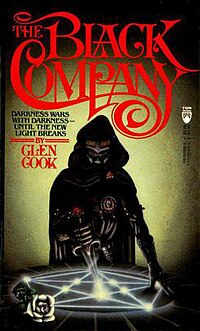 What I did end up thinking about was how Cook inverts this element of Tolkien just as he does the elements of innocence, high language, careful history and culture and so on. At the close of the series (the first trilogy), the rising evil has been put down again, but whereas in Tolkien the evil is finally once and for all destroyed through the power of grace (or coincidence, if you prefer), in Cook there is no grace to deliver us. There is no higher power that awaits one who will make the final sacrifice in order to ensure the safety of the rest.
In Cook, there is no Solution to the Solution.
Evil gets hammered down and people make sacrifices in order to encourage safety, but in Cook's world there is no surety. Evil always waits. It always finds a way back, as long as there exist people who are willing to screw over their fellows for an advantage.
The Third Age ends and the threat of Sauron is gone. The final servant of Morgoth is destroyed and the world is at last safe for mortal souls.
The White Rose and the Lady square off over the Dominator and the world is NOT safe. It is no safer than it was. No Age comes to an end, no final solution is arrived at.
Cook's is a perspective that comes after too many wars have been fought to end war. Too many efforts to solve all problems. Too many Final Solutions. Not only is there never One Ring To Rule Them All, but there is never an end to Rings and those who wish to Rule Them All.
Monday, September 03, 2007
Pure Pop: "Terrible"
posted by barsoomcore
 Nobody, but nobody, does pop music like the Japanese. They are simply the masters when it comes to smooth production, gorgeous song structure and soaring emotions. "go for it!" by Dreams Come True remains probably the greatest pop tune I've ever heard in my life.
At last year's Vancouver Film Festival we had to make some tough choices, and one film in particular that we only cut from our schedule with the heaviest of hearts was Linda Linda Linda, a seemingly frothy tale of four Japanese high school girls who form a punk band.
Fortunately, Linda Linda Linda received a DVD release sufficient to reach our neighborhood video shop, and Steph snagged it from the shelves last week.
And the cinematic tradition in Japan remains as solid as ever. Linda Linda Linda is as delightful as it is stripped-down. No tricks, no pandering, no over-statement or pretentious under-statement. Four extremely charming young ladies, a couple of unbelievably catchy punk-pop tunes and the never-failing drama of needing to deliver when the time comes. Along with the never-failing heart-warmth of friends helping each other get to that time.
There's a great moment in Linda Linda Linda -- the girls manage their first practice, and Kei, the "cool" one who's the ringleader of the crew, makes a complete hash of her guitar part. Nozomi shakes her head and laughs, "Kei, Kei, Kei... Terrible." And they all laugh and practice carries on.
We were watching Moonlighting this morning and Steph remarked how the thing about Dave and Maddie is that they make each other better people. Same holds true in this film. All four of the girls are immeasurably improved by each others' determination to help make their performance a success. Without giving away too much of the plot, the real story here is not about any one girl overcoming her problems (it's in fact debatable whether many problems are in fact overcome), but about the group lifting each other up in order to reach that moment, that time when delivery is required.
I suspect most of us are masters of avoiding that time. Of staying clear of the need to deliver. When I realise that such a moment is bearing down on me, my first reaction is always panic. I'm not ready. I've got a few things I need to get in order before I take care of that. I'll just put it off for today. Get to it soon. Real soon.
And yet, there's a part of me that seeks out such moments. That craves the inner knowledge, the discovery that comes from those moments where there's no more avoiding, no more getting things in order, no more real soon. When it's time to put up or shut up. I think one thing I've learned is that failing at such moments is never quite as world-ending as my fears whisper it will be. But then I've been blessed with friends just as warm and honest as Nozomi the bass player. And whenever I blow a line or miss an entrance, I can just recall that headshaking "Kei, Kei, Kei..."
Monday, August 06, 2007
The Queen. Mother.
posted by barsoomcore
 Queen Elizabeth II was always a presence in our house. I can recall my mother's tales of how her mother would teach them proper tables manners with the admonition that they needed to know how to eat properly with the Queen.
Should the occasion arise, I have no doubt my mother would comport herself with her usual dignity.
I on the other hand have become fatally fond of slurping hot beverages. I doubt I'd survive tea.
Of course, my mother's tales formed their own admonitions for us kids. Unspoken behind the story of how SHE was taught lay the assumption that, as unlikely as it sounded, being prepared for royal dinners was pretty much the foundation upon which Western Civilization rested.
Somehow, to an eight-year-old in Prince George, it never actually sounded all that unlikely. My mom can be awfully convincing.
Steph has accused me of radical monarchism. I deny the charge, of course, but I do admit that I am awfully fond of the Queen. I think she's just great. Respectable. Strong. Really, everything the Commonwealth needed over the last 55 years in a head of state. Maybe not the greatest mother ever (if one judges a parent by the children, as one inevitably must), but well, "great", "respectable", and "strong" don't mean "perfect", now do they?
No they do not.
You know her coronation took place just two months after her grandmother dropped dead? Good old Queen Mary insisted the ceremony not be delayed on account of her death. No sense making a fuss over what you can do nothing about.
I may be getting ahead of myself here. But we watched Helen Mirren's astonishing performance in Stephen Frears' The Queen last night, and such viewing naturally leads to speculation on things royal.
As Steph said, you have to respect a film that can make you feel at least a little sorry for Prince Charles.
It's okay, the feeling passes quickly enough.
The feeling that remains, however, is "I bet my mom LOVED this. I bet she ate it up."
Of course the film is primarily about the astounding performance from Mirren. At one point the Queen has to get out of a vehicle into a reasonably inconvenient amount of water. Steph stopped the film to turn to me and say, "I'm just now realising that that's not ACTUALLY the Queen."
In fact, for just a second, in my mind, I was thinking, "Man, I'm glad I'm not the AD who had to tell the Queen they needed another take of her stepping into that cold water."
And then, once we'd settled down, I thought, "You know, I bet the Queen would be a trouper about it."
Everyone knows it's a tremendous performance. There would have been riots if Mirren hadn't won the Oscar for that performance.
Well-mannered, stoical sorts of riots, of course, but still. Riotish.
But the film itself is likewise tremendous. You MIGHT say the bit with the stag teetered on the edge of overwrought, but I'm more than willing to give that to Frears. It is more than made up for by the moment when the Queen at last confronts her grieving, hysterical public. I'm not ashamed to say I misted up then.
Why? Helen Mirren manages a stiff Queen smile and folks curtsey to her. The music doesn't swell up all grandiose and stuff. Nobody's crying out in unabashed agony. It's a small, private moment. And yet, in that moment I felt the story touched on a notion, a feeling of necessity that was at once beautiful and tragic. That a woman can devote her life to something with no expectation of personal satisfaction (beyond being the richest woman in the world, of course -- THAT must be rough), and unexpectedly receive a quiet kindness from a small group of strangers. What Mirren really accomplishes here is to show us how much that little, little thing MEANT to her character, without needing to resort to any clumsy tricks. Just that stiff yet warm smile.
To see that reached inside me.
I believe in stoicism. That will surprise (and most likely amuse) folks of my casual acquaintance -- I know I come across as pretty much a loud-mouthed goofball, and perhaps this is a case where I'm just not capable of practicing what I preach. But I really truly believe that standing firm in the face of pain and enduring is morally healthy. Plain and simple: quiet, unobserved, unshared suffering builds character.
My mom is the queen (ha) of such thinking. Her suffering has all her life been quiet, unobserved and unshared. And so when Elizabeth managed that smile, I felt I knew what it cost her. To not rail against the unfairness that had stolen her people's hearts from her. To not give vent to the ugliest feelings inside her.
There's something about watching people making the compassionate choice, when you can see they have solid reasons to be selfish, that always gets me. People being strong for others, and discovering inside them more strength than they knew they had.
My mom has done that for me more times than I could possibly count or repay. She is the strongest person I know.
And if I ever chance to sit down for dinner with Queen Elizabeth II, I will most certainly inform Her Majesty why I seem so non-nonplussed at the occasion.
"My mom taught me what to do."
Thanks, mom.
Tuesday, May 22, 2007
From High Above
posted by barsoomcore
From 40,000 feet the entire breadth of North America is cross-hatched in endless rectangles, precisely delineated. Not one inch of the continent is free of this demarcation, this immense subdivision of what was once a vast wilderness.
Where can adventure live in such a carefully enscribed landscape? Where in all this is there room for the unknown, for mystery, for that thrilling understanding that comes from facing what has never before been faced? And what does it mean that there is no longer any forest left for the knight to go adventuring in? What is a castle when all the world is fortified?
 No wonder fantasy novels are so popular nowadays. A new world can be fashioned, a world that still offers dark corners unexplored, that still holds mysteries for brave hearts to test themselves against.
No wonder, too, that investigative dramas have always done so well. Observe the clues, make the diagnosis, and the problem is solved, 42 minutes later. Such stories repeat in our daily life the truth that emerges when one soars above this thoroughly-settled land. That all ferocity can eventually be tamed, that all terrors can ultimately be faced and fought down, and that all mysteries will inevitably give up their secrets and settle into the mundane.
Both stories -- the story of mystery's ongoing existence, and the story of rationality's ongoing campaign against mystery -- succor us and our deepest fears. If there is no more mystery, we fear, then there are no secrets within ourselves. There is no uniqueness to our soul, nothing that makes us different from the myriad others. But if mystery cannot be defeated by rationality, then there is no chance of us ever knowing ourselves truly.
And of course, if we cannot delve into our own wildernesses and tame them, subdivide them and put up tract housing on what's left, we are left never knowing that the secret uniqueness to our hearts is in fact unique. Maybe we aren't. Maybe our so-precious soul does not exist, and all that we are is a conglomeration of cells, seeking to reproduce themselves, and that our own sense of consciousness is simply a side-effect of that process, with no meaning in itself.
Reading Steven Erikson's newest novel, Reaper's Gale, brings forth such thoughts. This fantasy epic has become a political and philosophical journey, and Erikson is proving to be a frustrating and rewarding guide through some very difficult terrain. There are no easy answers in all this. There aren't even any difficult answers. Just one difficult question after another. Silchas Ruin asks, "What gives your life meaning, Udinaas?" and Udinaas can only laugh bitterly, and retort, "Ask me something interesting."
What fascinates me the most about that exchange is that, by all ordinary standards of judgement, Ruin should be the character we are most interested in, the one who inspires our identification (versus sympathy, we've talked about this before). We SHOULD want to be more like Ruin, with his tragic past, his super-powers, his certainty. And yet it is Udinaas, the slave, the cynical and weary one who refuses all grand purposes, who draws us to him. His disinterest in the meaninglessness of humanity's self-flagellation mirrors the disinterest of those roads in the meaninglessness of North America's vast surface.
At 40,000 feet, the only evidence that humanity exists is the regularity of our roads and the indifferent lines they cut across the indifferent landscape. Two vast disinterests set against one another. Is it a tragedy that the wilderness now exists only in our hearts (if it exists at all)? Or is it a blessing? Now that we can no longer be distracted by our desire to tame the land, are we more easily engaged in the project of taming ourselves? And is that project something to give our lives meaning? Or is it just building more roads across more landscapes, neither engaging with the other, while we fly on, far overhead?
Or do I need to find an interesting question?
Where can adventure live in such a carefully enscribed landscape? Where in all this is there room for the unknown, for mystery, for that thrilling understanding that comes from facing what has never before been faced? And what does it mean that there is no longer any forest left for the knight to go adventuring in? What is a castle when all the world is fortified?
No wonder fantasy novels are so popular nowadays. A new world can be fashioned, a world that still offers dark corners unexplored, that still holds mysteries for brave hearts to test themselves against.No wonder, too, that investigative dramas have always done so well. Observe the clues, make the diagnosis, and the problem is solved, 42 minutes later. Such stories repeat in our daily life the truth that emerges when one soars above this thoroughly-settled land. That all ferocity can eventually be tamed, that all terrors can ultimately be faced and fought down, and that all mysteries will inevitably give up their secrets and settle into the mundane.
Both stories -- the story of mystery's ongoing existence, and the story of rationality's ongoing campaign against mystery -- succor us and our deepest fears. If there is no more mystery, we fear, then there are no secrets within ourselves. There is no uniqueness to our soul, nothing that makes us different from the myriad others. But if mystery cannot be defeated by rationality, then there is no chance of us ever knowing ourselves truly.
And of course, if we cannot delve into our own wildernesses and tame them, subdivide them and put up tract housing on what's left, we are left never knowing that the secret uniqueness to our hearts is in fact unique. Maybe we aren't. Maybe our so-precious soul does not exist, and all that we are is a conglomeration of cells, seeking to reproduce themselves, and that our own sense of consciousness is simply a side-effect of that process, with no meaning in itself.
Reading Steven Erikson's newest novel, Reaper's Gale, brings forth such thoughts. This fantasy epic has become a political and philosophical journey, and Erikson is proving to be a frustrating and rewarding guide through some very difficult terrain. There are no easy answers in all this. There aren't even any difficult answers. Just one difficult question after another. Silchas Ruin asks, "What gives your life meaning, Udinaas?" and Udinaas can only laugh bitterly, and retort, "Ask me something interesting."
What fascinates me the most about that exchange is that, by all ordinary standards of judgement, Ruin should be the character we are most interested in, the one who inspires our identification (versus sympathy, we've talked about this before). We SHOULD want to be more like Ruin, with his tragic past, his super-powers, his certainty. And yet it is Udinaas, the slave, the cynical and weary one who refuses all grand purposes, who draws us to him. His disinterest in the meaninglessness of humanity's self-flagellation mirrors the disinterest of those roads in the meaninglessness of North America's vast surface.
At 40,000 feet, the only evidence that humanity exists is the regularity of our roads and the indifferent lines they cut across the indifferent landscape. Two vast disinterests set against one another. Is it a tragedy that the wilderness now exists only in our hearts (if it exists at all)? Or is it a blessing? Now that we can no longer be distracted by our desire to tame the land, are we more easily engaged in the project of taming ourselves? And is that project something to give our lives meaning? Or is it just building more roads across more landscapes, neither engaging with the other, while we fly on, far overhead?
Or do I need to find an interesting question?
Friday, April 27, 2007
Mummy Pimp: Pointless But Good
posted by barsoomcore
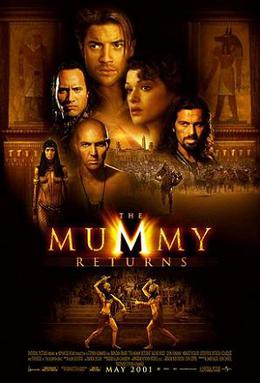 Why aren't Brendan Fraser, Rachel Weiss and Oded Fehr in EVERY movie? Patricia Velasquez and Arnold Vosloo can come along, too. And heck, why leave out John Hannah and Kevin J. O'Connor?
One thing you gotta give up for The Mummy Returns: the fight scenes are fan-bleeding-tastic. And I'm a sucker of how Sommers stages his stuff. That fight scene in the O'Connell house is set up BEAUTIFUL.
LIGHNTING FLASH LIGHTNING FLASH
"We'll take the box."
EVELYN TAKES A BAD-ASS PILL
"I don't think so."
LIGHTNING FLASH LIGHTNING FLASH, BAD GUYS POUR IN
"Then we'll kill you, and take the box anyway."
ENTER ODED FEHR
"I think not."
Come on! If you're not on board with that, go down to the community center and buy yourself some bingo cards. Get one of those stamper things so you can run four or five cards at the same time.
Because then there's a totally awesome fight scene, and then machine guns go off, and capes swirl, and cars go zoom zoom crash roar, and more machine guns, and mummies and guys getting ratchetted backwards into pools of fire, and explosions, and Rachel Weiss and come on.
Look, I know what you're going to say. You're going to say that The Mummy Returns is insipid. Stupid. Derivative. Way too complicated for its own good (WHY do they make a big deal about somebody opening the chest so the Mummy can suck them dry? Good grief). Stupid. Tedious. Full of fake-looking CGI effects. Featuring bad astronomy. Stupid.
 I can't argue with any of that. And yet I am helpless before this film. I LOVE this film. I just love watching Fraser and Weiss and Fehr banter and throw punches and shoot things and scream a lot. They're all so very charming.
And they do a LOT. A lot happens in this film. And while that kind of LOOKS like a problem, I think it's not really the problem. I've spoken about the films of Tsui Hark and how they seem so incredibly stuffed full of stuff, and that's a good thing. There, it works. Here, Sommers does too much.
Part of the problem is the large amount of NEEDLESS stuff. The story itself isn't all that complicated, but there's all these subplots and goofy things taking up your screen time. Compare it with Peking Opera Blues. I've seen that film twenty times or more, but I still don't think I could relate the plot to you. I don't really know what it's about, but I do know that it's totally awesome.
On the other hand, it doesn't feature Oded Fehr with a hawk:

That bit always cracks me up. Half way through the film, and Fehr's already several times cooler than anyone you know, and he just sort of casually turns around and says, "Oh yeah, AND I have this trained hawk that comes whenever I call."
That's pimp. Oded Fehr is like the Ancient Guardian Pimp-Master Supreme. And he's got a few thousand bad-ass characters that can show up and just ride around Egypt for a few days. With, you know, swords and turbans and trained hawks (named Horus -- bet there's a lot of hawks named Horus over Egypt-land). That's just how the Pimp-Master Supreme rolls.
It's like Superman mentioning, just in passing, as he's rattling off all his super-powers, that he's also a cordon blue chef. Pimp.
I know, I know. You could cut an hour out of this movie and miss none of it. Especially if it was the hour featuring that kid.
(WHY do people put children in their movies? It's a mystery.)
Damn, but this is scattered. I haven't even gotten to the pygmy mummies swinging on vines.
Or THAT GUY.
Okay, I don't know if anyone else in the world has ever noticed this, but like I say, I LOVE this movie. So there's this guy who shows up right at the start. He's just some mook in a red turban, pointing a gun at the sub-bad guys (the Cockney adventurers (who I would TOTALLY go see a movie about, damn that's a good idea Corey)). THAT GUY shows up again and again throughout the movie, and every time he just keeps avoiding death. He chucks a knife at O'Connell that our hero catches and flings back, and THAT GUY leans aside and lets the knife take his buddy in the chest. He empties his Luger at O'Connell and then ducks the return fire AGAIN.
This goes on for the whole move. THAT GUY keeps avoiding certain death again and again, until at last he is unable to cheat it any longer. But I'm pretty sure he's the very last red-turban mook to go down. Go watch it, you'll see. He's got no lines, but he's one of my favourite characters in the whole picture.
And he's one of the things that redeems this hopeless, messy, stupid stupid stupid picture for me. I mean, there's no earthly reason for it. Why keep having this guy narrowly avoid death again and again? Nobody notices who watches the film once. Or even ten times.
(Yes, yes I have watched it more than ten times)
There's no PURPOSE to it, and THAT'S what lurks around at the heart of this film that touches me. Somebody (let us assume Mr. Sommers) just put that running gag in the picture because it amused them. And whatever other qualities this film may possess, it at least feels like a film made by people who really WANTED to make it.
It's two o'clock in the morning and I'm only half-way through, and I know this isn't making a lot of sense, but hell. Neither does The Mummy Returns and you sat through that didn't you?
Well, I did.
Friday, April 13, 2007
The Myth: Insufficient Baggage
posted by barsoomcore
 Jackie Chan's recent move The Myth is probably the best thing he's done in nearly a decade, but given the decade in question, that's not saying much.
It's been seven years since he made Shanghai Noon, the last film that was arguably as good as this, and thirteen years since Drunken Master II -- his last truly great film.
The Myth is NOT a great film. It does at least have three or four great "bits" -- and "bits" are really the key atomic element of a Jackie Chan film. I can't remember the plots of most of them, but you can remember the bits. The bit in Armour of God with the flaming log and the four black women, or the bit in Miracles in the flour mill or whatever that was, or the bit in Project A Part II in May's house. In The Myth there's a bit on a sticky conveyer belt that's worth the price of admission alone (assuming that price is a $3 DVD rental) and shows more invention and physical brilliance than pretty much anything I've seen since the last time I watched a Jackie Chan film.
But it's a dissatisfying movie, and I think I'm getting a glimmer as to what's wrong with Jackie Chan: he's getting old.
That's not to say he can't do the moves: The Myth puts that notion to rest. Even if he isn't as fast or as insane as he once was (and he's still pretty insane), his real gift always was his ability to dream up crazy shit, not just to perform it. But he's what you'd call a "mature" fella now, and that implies something for the types of characters he can play.
 He needs to play characters with baggage.
In his youth, he was fresh-faced and cheerful, and you never really worried about where this guy had been BEFORE the story took off. His characters are mostly blank slates, just average joes with no great pains or accomplishments we needed to worry about before the opening credits finished. Which was fine, when Jackie looked 20. You can easily accept a 20-year-old who's never really done anything in his life.
But Jackie doesn't look 20 anymore. He looks 50. And a 50-year-old who's never done anything is a whole other story. The whole thing feels fake, put-on, and you feel the creakiness of the story mechanics too acutely. It's not that you can't tell a good story about a 50-year-old, but that story has to START somewhere. There has to be some history to this person, so that we feel like they have things at stake.
It is good to see Jackie stretching his chops here, both acting-wise and action-wise -- there's a couple of large-scale action sequences that are handled well. But ultimately it all comes down to story, and a story about a man who is presented as a child just won't carry enough weight to make us care.
Jackie will always get a free pass with me. He's got nothing to prove -- he's already a genius. He's already one of the most important film-makers in history. I'll watch whatever he's got again and again, and if there's at least something worthwhile in it I won't complain.
But it's hard to see him not living up to the potential I know he possesses.
...
 In other news, if you needed evidence that Bollywood is better, lookee here: at some awards show, when the nominee gets her award, she doesn't get ushered off-stage; she bursts into song!
(it's possible I'm not in full possession of the facts in this case but look at her face! Tell that's not a happy singing Indian woman right there. Tell me you aren't happier just for having seen her. Go on. Tell me. No, wait. Don't tell me. Leave me to my happy, poorly-verified worldview)
Thursday, March 22, 2007
Cinema of Gesture
posted by barsoomcore
 At long last Steph and I settled down to watch Tsui Hark's Green Snake, a film alternately praised and reviled by critics. Teleport City praises it, but their reliability is shaky with us (why would anyone praise crap like The Stormriders?) The girl at the video store LOVED it, but she loved Vampire Hunters: The Twin Effect, so who knows? Tsui Hark (especially in these later years) has been pretty hit-or-miss, too (I still feel bad for Anita Mui in The Magic Crane), so there was justifiable trepidation on our part.
But Maggie was in it, and we'll forgive a lot for a bit of Maggie Cheung's charm and chops.
By the same token, it hurts to see those charms and chops mishandled. It can be done. Of course it takes great effort and determination, but look what those yahoos did with Penelope Cruz and Salma Hayek in Bandidas. You can't take these things for granted.
Fortunately, all of Maggie's talents get plenty of exposure here. This films starts with her dropping naked into an already-pretty-sexed up Indian dance number and getting awfully friendly with the ten ladies dancing. As Steph noted, it keeps your eyebrows pretty high up on your head for quite some time.
Tsui Hark, to his eternal blessedness, does NOT fall into the trap that the makers of Bandidas did: he recognizes that his primary job is to show off the tremendous beauty of his two leading ladies, Maggie and Joey Wong, and keeps that front and center throughout. Speaking of Joey, she's pretty enough, but doesn't she always sort of look like she's stoned out of her mind? Look:

See? Anyway, on with the show.
 Large portions of this film are devoted to loving slow-motion shots of the two ladies more-or-less (or even completely) undressed, rolling around with each other in the rain or in a flower-filled bathtub. It's hard to hate. Especially when even that stuff never outstays its welcome.
I think one of the secrets to Tsui Hark's great films (besides his boundless imagination and ability to find brilliant actors) is how nothing ever outstays its welcome.
There's a couple of moments in Green Snake where White (the ladies play snake spirits, one named White (Wong) and the other Green (Cheung)) uses her magic powers to cause it to rain. She does so by tossing a cupful of wine into the air. The flying liquid is photographed in slow motion, of course, but with that Tsui Hark insouciance that renders it quick and lightweight as his best films are. Steph noted how different that moment would be in the hands of a director like Zhang Yimou, with half-a-dozen closeups and heart-breaking cinematography, an epic score swelling, showing his audience every detail, whereas Hark just sort of indicates what's happening.
"Look, she's got a cup, she chucks it in the air, it rains. Got it? Good, we're moving on."
Hark's way isn't necessarily better or anything, but I think this notion of indicating, of gesturing, goes a long way to explaining the lightness of these films.
One of the basic problems in "live" cinema (as opposed to animation) is that everything you point your camera at looks like whatever it is. Which, if you've got a jones to make films about sorcerers, martial artists who can fly, and snake sisters who just want a little loving, makes life very difficult. Hence special effects, which, when they work, take your audience with you on your fantastic voyage, and when they don't, make you look stupid.
But either way, they don't seem to contribute to the idea of "sketching" in cinema. It seems at first glance that this isn't even possible. Special effects or not, whatever you point your camera at, you get what you film. How do you indicate that your hero is walking into a house? You get your actor, and a house, and have him walk into it while the camera rolls. There's no indicating. Just showing.
But Hark overcomes this problem with something cinema has that static art cannot: speed. By accelerating the pace of everything until only the barest gestures indicate what's happening, Hark strips cinema down to what is, in essence, a sketch. The paradox of course is that his films are so lush and so beautifully shot that to speak of him "stripping down" cinema seems absurd. But I'm convinced that what's going on here in Green Snake.
 When our heroines unload their awesome magical powers, there's very little in the way of depiction. Basically, they stand on a fake hilltop and wave their arms around. There's some smoke and some trickery, but it happens very fast and really, you just get shown enough so you can figure out what's going on. Then it's on to the next thing. The speed of the narrative, the incredible rate at which things happen, makes Hark's casual indicating of each moment acceptable. If the story didn't move at such a breakneck pace, this light touch would feel unfinished and hollow. It wouldn't satisfy, maybe only because you'd have enough time to say, "Wait a minute. That's pretty obviously a paper-mache snake Maggie Cheung's rolling around in the water with." Instead, you get just enough time for your brain to say, "Holy crap, lookit Maggie rolling around in the water. I guess that's a snake there with her." And then you're off to the next bit.
It appeals to me because at heart I'm that kind of storyteller. I'm not a careful plotter or a thoughtful developer of deep characters. I just like to have lots of shit happen. I'm an "And Then" storyteller: "And then they fell off the cliff. And then a giant mosquito caught them. And then the mosquito got squished by a giant flyswatter. And then..."
I can appreciate Zhang Yimou's determination to make every moment of his films rich with beauty and potency. It's lovely when it works (and incredibly tedious when it doesn't). But something in me responds to Hark's witty, rapid-fire lightness more enthusiastically.
Sunday, March 18, 2007
Trusting Old People
posted by barsoomcore
 Andrew Currie's just-released feature film Fido is a very charming, amusing and even heart-warming take on the zombie film. If you can imagine that. I'm sure you can, you're very imaginative.
One gets the feeling the idea for this film came from those last couple of minutes of Shaun of the Dead, with zombies carrying shopping bags and so on. Currie's film takes place in a world where the zombies have been domesticated (with the occasional failure here and there), and the world is now in the grip of fanatical security-minded zombie-hunters.
There's much gentle satire throughout the film, and Currie uses the zombie metaphor to bounce a variety of topics out at the audience. Targets such as security-justified losses of civil rights, paranoia, abuse of undesirables and neglect of the elderly all get clever shots taken at them.
"You can't trust old people. Any second you might turn around and find Grandpa coming for your throat."
It's all handled with admirable subtlety.
The young K'Sun Ray (I just report 'em, I don't make 'em up) carries the film as Timmy Robinson, with the help of Billy Connolly's hilarious turn as the zombie dubbed Fido (a joke that pays off better than you think it will a couple of times), but it's Carrie-Ann Moss' Helen Robinson, who goes from shallow "what-will-the-neighbors-think" paranoia to bold and fearless defender of her unconventional son without a moment out of place or awkward, who really lights up this film. Moss' performance is both savage and sympathetic, and her transformation is the heart of the whole story.
 The early parts of the film echo Brad Bird's The Iron Giant in their mockery of mid-20th-century self-righteous propaganda, but Fido's got different axes on the grindstone than did Mr. Bird. Even with the same basic idea of a young boy who befriends a stranger that adults view with fear, Currie ventures into distinctly more uncomfortable terrain than Bird. Timmy's burgeoning friendship with Fido, as pathetic as it is, unravels the society around him, peeling away the layers of hypocrisy that allow everyone to deal with the unending terror of a world beset with the walking dead.
It is in this hypocrisy and its gleeful manifestations that Fido really shines. One of the ideas the film toys with is the difficulty so many of us having with forming strong attachments to others. We get hurt and we grow cynical and refuse to open our hearts to one another, to spare ourselves the pain of being betrayed yet again. Of course, in a world where your loved ones will rise from the dead and seek your braaaaaiiiinnnnnssss, there are whole levels to betrayal we rarely have to worry about.
If Grandad suffers a heart attack upstairs and dies in bed, he'll be coming downstairs looking for living flesh before you know he's a goner. This is exactly what happened to Timmy's father, and the poor man's trauma is both heart-rending and hilarious. Of course, the film fights against Dad's fear, and tells us that reaching out to others IS worth doing. Even when the "other" is a flesh-eating monster.
A worthy point, and made with exuberant savagery towards those who counsel paranoia (a fitting and relevant theme these days), but ultimately the film suffers from being unable to get past its own sentimentality. Everyone and everything is attacked in this film EXCEPT this notion, and that speaks of a lack of courage on the part of the film-makers. Truly great satire (it was Steph who convinced me of this) requires unflinching focus and follow-through. A great satire like Time Bandits leaves NO sentiment unscathed and no character unspotted with flung muck. Fido is, ultimately, too sentimental to turns its satirical gaze on Timmy's devotion.
A sentimental zombie film? Truly we are witnessing a passage in our culture.
Fido is charming and occasionally gut-bustingly funny in a clever and savage fashion that is quite welcome in this age of gross-out comedy.
And it suggests that a DEAD father is in many ways a superior parent to a LIVE father. Especially as they get older. Because you just can't trust old people.
Monday, March 12, 2007
One In A Hundred
posted by barsoomcore
 Zack Snyder's 300 is a fantastic bit of puffy/silly cinematic hoobajoobery. Decapitations, orgies, naked male torsos, horrible death, rape (sort of... more on that later) and a final sacrifice justified through terrible retribution.
And three, well, I can only call them ERRORS, two of which weaken the story, and rob it of true greatness, and one of which... one of which... actually kind of makes it MORE interesting.
But first off, let me come clean on Zack Snyder. I have consistently trashed his remake of Dawn of the Dead, and expressed a lot of scepticism regarding 300 when I heard he was attached. Early trailers and behind-the-scenes footage only increased my concern. But Snyder has overcome my concerns: his handling of Miller's story is exceptional. He manages the fight scenes (and basically, this movie is an extended fight scene) very well: allowing confusion to reign when it should, but providing clarity at the exact moments it's required.
He seems to have understood that this is not a film of traditional suspense; the audience is for the most part well aware of what's about to happen at each stage in the story. His job has not been to surprise his audience or defeat their expectations -- instead he is required to fulfill those expectations and find little more than innovative stagings to provide the novelty that the story does not.
Good example is the death of the battle rhino. First off, battle rhinos are good. All films with battle rhinos charging like berserk Cadillacs with four-foot hood ornaments are made better for the inclusion. You're never sorry you put a battle rhino in your picture. Even Muppets like Battle Rhinos:

Er.
You know the scene: enraged battle rhino charging towards our hero. One heroic figure stands unconcerned as several tons of CGI monster come barreling forward, and blithely chucks a spear at it. You KNOW how this ends, so the only thing to watch for is how Snyder shows it to you.
Anyway, Snyder gets the job done here and elsewhere throughout the film with verve and an uncompromising vision. A couple of times the effects stutter, but for the most part you can sit back and get blown away.
So Zack, I'm in your corner now, and looking forward to your next film. You exceeded my expectations and made for us a damn fine movie, full of some very impressive effects.
Part of what makes any effects shots work, of course, is the performance of the actors. Gerard Butler pulls off the required frenzy of bloodlust and savage determination for Miller's interpretation of King Leonidas, which is really the only performance in the film that matters. The other Spartans have to shout a lot, and King Xerxes has to look freaky, and then there's Leonidas' wife, Queen Gorgo. Sadly, not this Gorgo:

But Lena Headey's character brings us to the first of my three issues with 300: Queen Gorgo turns out to be either stupid or a slut.
Spoilers ahead: if you haven't seen 300, you might want to give the rest of this post a miss.
Gorgo wants the Spartan council to send aid to Leonidas (her hubby) and his beleaguered soldiers. To do so, she requires the support of the Spartan bad guy, Theron. She meets Theron and asks for his assistance. He's willing to help... if she's willing to stray a little from her marital vows.
Gorgo doesn't even protest. She doesn't try any other ways to convince Theron. She doesn't even extract any promises from him (much less WAIT until he's actually done anything helpful before giving up the lid on her honeypot). It's just, "Hey, baby" and she drops her toga.
 This is the woman who is married to King Leonidas, the guy who's so unbelievably righteous he murders messengers just for not being polite enough. Head of a society so rigid little kids are sent out into hostile wastes to prove they deserve a place among their elders. It's unclear, but presumably marriage vows are handled with similar ferocity and lack of compromise.
And so when Gorgo offers herself up to a man she knows is deceitful and cowardly, we lose all respect for her. Either she's stupid, making such an ill-considered deal (which turns out poorly for her, until vengeful murder has its way), or her marriage vows just aren't very important to her. When the moment comes, all I could think is, "Leonidas would rather die than come home to his wife an adulterer." Clearly he would, and if I can see that, how come his wife can't?
It's a disappointing story decision that robs the final act of the film of much of its power. Gorgo's (and by proxy, Leonidas') honour is saved by coincidence rather than her own strength and it seems so terribly out of character with her behaviour in the first half of the film that it's hard to accept.
But by no means does the film fall apart. There are still goosebumps and "Fuck yeah!" moments aplenty. These Spartans are here to fight, and fight they do. Although they seem to relinquish their vaunted discipline pretty quickly in favour of wild-ass action scenes.
Not that I'm complaining -- I'm a long-time lover of the wild-ass action. But if I were Ephialtes the hunchback, and I'd been told by Leonidas that I wasn't welcome to join the Spartans because their incredibly disciplined fighting style meant that his handicaps would endanger the men around him, I'd be a little pissed at watched the Spartans then go down and fight in wild melees, where no discipline holds sway at all. Leonidas lies to Ephialtes, there's no other way to describe it.
And this is another disappointing decision. Better had Leonidas simply said, "No, you're ugly and we don't fight with ugly people," or had the Spartan's actual fighting style resembled his description, than this weak-kneed, cheaply thrown-together escape from the film's own cold-hearted premises. We can't make Leonidas TOO bad, otherwise the audience won't like him, so we'll PRETEND there's a legitimate excuse for him sending Ephialtes away, but then we won't abide by the conditions that excuse imposes on our choreography.
It would have been interesting to see the Spartans fight in strict hoplite formation (probably not historically accurate, but let's remember the battle rhinos, yes?). A challenge for a director to make such rigid formation and fighting style interesting. It would likewise have been interesting to see Leonidas' snobbery for what it is: a refusal to accept that which is different. A refusal to value contributions that do not carry the agreed-upon, external signs of greatness.
Sadly, the story does not offer either of those interesting possibilities, and so the audience is asked to accept a weak excuse to make the director's job easier. Disappointing.
 Leonidas is a typical (one might say stereotypical) Miller hero: possessed of unquestioning confidence in his own moral judgement, which is of course backed up by his unmatchable physical prowess. Miller's universes mostly figure physical prowess as demonstrative of moral rectitude. His rejection of Ephialtes is unsurprising, indeed, necessary, in order that the moral quality of the film's universe remain consistent. There cannot be discord amongst the rippling torsos of the Spartans. There can't even be hairy chests, which for a bunch of Greek guys has to be considered one of the most egregious anachronisms of the film (followed closely by David Wenham's BLONDE Spartan).
But Leonidas possesses a self-serving cynicism unlike that of Batman, any of his Sin City tough guys, or even Garrett from Elektra: Assassin (the most cynical and interesting of all Miller's heroes). He flouts Spartan law by leading his soldiers to Thermopylae, travelling to battle on the thinnest of excuses, but when the moment of crisis comes and he must justify leading his men to their own deaths, on what does he base the moral foundation of his decision? Spartan law.
How can this be? How can his men accept this sudden demand that they follow the laws they've already walked themselves in violation of? Why would Leonidas, in violation of Spartan law (and willfully so), suddenly revert to demanding that those laws be upheld?
This is the decision that does NOT weaken the story. It reveals the bizarre and tortorous moral logic that this story rests upon, and renders the tale all the more fascinating for its momentary lifting of the lid of certainty and righteousness. For just a moment, we see Leonidas' self-centered will driving him forward to death. And his unwillingness to take the responsibility for the slaughter he is leading his men towards diminishes him fractionally, crucially, and reveals within him his own insecurity and fear. Because we know perfectly well that his men would stand and fight just because he told them to. He doesn't NEED the shelter of the law. He needs nothing more than his own infectious courage.
Externally, Miller's Leonidas is a man immune to uncertainty. He always knows what's right. He has no doubt in the righteousness of his efforts. But inwardly, he cannot bear the weight of that righteousness. Inwardly he must rely on that which he knows to be hollow: the laws of his kingdom and the honour and love of his (adulterous) wife. In his last moment he calls out for her, violating the Spartan code of hardness and strength (actual dialogue: "Spartans must be hard and strong. They must be hard. They must be strong."), for a woman who has already betrayed his trust.
It's in the failures that 300 is most interesting. It's a grand film, full of cinematic joy, and head and shoulder above most of what we get offered nowadays. Zack Snyder has taken Rodriguez' vision of "pure" cinema, unfettered by studios, sets or locations, and pushed it even further beyond what we have seen before. If it had been a little bit more aware of its own weaknesses, it would have been great.
Friday, March 02, 2007
An Ugly Lesson In Beauty
posted by barsoomcore
Okay, I know nothing really writes itself, but seriously, if anything was going to write itself, it has to be this:
 Look! It's Salma Hayek and Penelope Cruz dressed up like cowgirls! Look at how charming they are! They've got guns, too! Cute hats! And it looks like a cowboy movie, so they probably ride around on horses, wear chaps and maybe corsets and look at them!
How could you POSSIBLY go wrong with this? I ask you, doesn't it seem like all you have to do is point your camera at these two and the rest is done for you? I mean, we know these ladies can really act, so have them fire their guns every so often, maybe throw a lariat and rob a bank and you can head for the beach. You'd have to really work hard to mess this up, don'tcha think?
Sadly, the folks who made this stinkbomb have an overactive work ethic.
And obviously don't appreciate the abilities and immense natural charm of their leading ladies. I don't think I've ever seen either woman photographed so clumsily, with such ineffective display of their considerable beauty.
Maybe this poster provides a clue to what went wrong:
 If anyone can explain how advertising a movie with Penelope Cruz and Salma Hayek by covering up their faces is a good idea, I'd love to hear it. I mean, come on, this is a total hamsmacker, and with any hamsmacker, your every effort ought to be towards selling the obvious. Penelope Cruz and Salma Hayek are beautiful women. Anyone who's going to see this movie is going to see it pretty much for that reason alone -- because they want to see Salma and Penelope dress up as cowgirls. Not cover their faces with hankerchiefs.
This dreary, horrible movie fails on so many levels I don't think I can be bothered to list them all, but the worst of the whole thing is that the ladies end up needing a guy to save their pretty heinies in the end. That tells you all you need to know.
And it's not even exploitative. It's just dull.
Go and rent the German movie Bandits for some awesome lady desperado action. And leave Bandidas out in the desert where it belongs.
Look! It's Salma Hayek and Penelope Cruz dressed up like cowgirls! Look at how charming they are! They've got guns, too! Cute hats! And it looks like a cowboy movie, so they probably ride around on horses, wear chaps and maybe corsets and look at them!How could you POSSIBLY go wrong with this? I ask you, doesn't it seem like all you have to do is point your camera at these two and the rest is done for you? I mean, we know these ladies can really act, so have them fire their guns every so often, maybe throw a lariat and rob a bank and you can head for the beach. You'd have to really work hard to mess this up, don'tcha think?
Sadly, the folks who made this stinkbomb have an overactive work ethic.
And obviously don't appreciate the abilities and immense natural charm of their leading ladies. I don't think I've ever seen either woman photographed so clumsily, with such ineffective display of their considerable beauty.
Maybe this poster provides a clue to what went wrong:
If anyone can explain how advertising a movie with Penelope Cruz and Salma Hayek by covering up their faces is a good idea, I'd love to hear it. I mean, come on, this is a total hamsmacker, and with any hamsmacker, your every effort ought to be towards selling the obvious. Penelope Cruz and Salma Hayek are beautiful women. Anyone who's going to see this movie is going to see it pretty much for that reason alone -- because they want to see Salma and Penelope dress up as cowgirls. Not cover their faces with hankerchiefs.This dreary, horrible movie fails on so many levels I don't think I can be bothered to list them all, but the worst of the whole thing is that the ladies end up needing a guy to save their pretty heinies in the end. That tells you all you need to know.
And it's not even exploitative. It's just dull.
Go and rent the German movie Bandits for some awesome lady desperado action. And leave Bandidas out in the desert where it belongs.
Thursday, February 08, 2007
Five Fingers: Walking A Fine Line
posted by barsoomcore
 Five Fingers: Port of Deceit is Privateer Press' latest release in their Iron Kingdoms line of products, and carries on the high standards this line has provided since the early days of d20 publishing, when The Witchfire Trilogy was one of the first d20 adventures to be published. The Iron Kingdoms is Privateer's unique Dungeons and Dragons setting that combines flintlock weapons, steam power, dragons, undead, and vast political machinations in a mix quite unlike any other campaign setting we've seen. This latest release describes in great detail the oddball metropolis of Five Fingers, notorious pirate haunt and key port on the coast of the nation of Ord.
Contributing strongly to the setting's appeal are the gorgeous illustrations by Privateer founders Matt Wilson and Brian Snoddy, which set the tone for this world. Nothing else looks like the Iron Kingdoms (or the companion minatures games, WarMachine and Hordes). But equally critical to the quality of these products, though less easily-presented, is the strong writing throughout, steered mainly by Doug Seacat over the years.
The Iron Kingdom products have a tradition of being "narrated" by characters in the world itself. And so the Iron Kingdoms World Guide features treatises on cosmology by a noted astrologer, and the Monsternomicon includes notes by Professor Pendrake, adventuring scholar of Corvis University. What could become into a stale and cliched device has served the Iron Kingdoms well, as each narrator proves to have a distinctive voice that nonetheless manages to communicate the required information without affectation. Five Fingers takes this welcome trend further, with no less than five narrators, each of whom offers a personal look into their part of this complex setting.
It's a good approach to city description, something I have rarely seen done well, especially with a true urban center like Five Fingers. I remember Judges' Guild's Citystate of the World Emperor, and while immensely detailed, it suffered from an inability to communicate the SENSE of the place -- its identity gets lost in the endless enumerations of shops and streets and so on. The GURPS folks put out a book on Tredroy, a crossroads city, that didn't do too badly, but suffered from a real lack of detail. Up to now, the most successful city supplements I'd seen were those from Flying Buffalo: the Citybooks. Rather than detail a complete city, they offered up a set of more-or-less independent shops, saloons, and other institutions you could drop into your own cities whenever needed. Very handy for the homebrewing DM who doesn't need to know each and every nook and cranny of the city, but does need to have something for those moments when the party decides that finding a candlemaker and asking HIM all about the bad guy's plan is just the thing to do. But they do nothing to provide a sense of place for a city.
Five Fingers walks a very nice line between the extremes of too much detail and not enough. The personalised accounts give a wonderful dose of flavour to the information, and provide useful breakdowns in the TYPES of information presented.
Because the problem of presenting an entire city and its workings is a complex one. Any given component (be it a place, or a person, or a tradition, or whatever) is going to intersect with a variety of other components, and might have variable importance depending on the context in which it's placed.
For example, the old cathedral in town will have significance to the city's history, to its current politics, to its appearance and so on. But just providing an enumerated list of every single component along with all its relevant factoids will fail to communicate how all these things work together to make the city into a cohesive whole. By giving the reader different perspectives on the city, the writers are able to emphasize those personalities and places that matter by having them come up in multiple narrations -- and at the same time to note the complex nature of all these interactions by giving it a different spin each time it's mentioned.
Instead of just insisting that this city is a complex assemblage of personalities, beliefs and cultures, the writers SHOW us through the strong voices of the different narrators, and their very different takes on the same institutions and realities of life in Five Fingers. It's an effective technique.
There's some solid crunch in here as well: rules for gang warfare, well-thought-out stat blocks for organizations and an interesting take on holy places/shrines. There's also a set of chase rules (everyone's got one these days! even Dungeon published a set a few months back!) that, cough, cough, I don't think are very playable, relying as they do on actual measurements of distances to obstacles and so on -- the very problem my humble Hot Pursuit was designed to overcome. But this isn't primarily a book of rules. It's a book that's meant to provide DMs and their players with a great backdrop for their stories. And at that, it succeeds very well.
Tuesday, January 09, 2007
Obedience School
posted by barsoomcore
Guillermo Del Toro seems to be on a crusade with his new movie, Pan's Labyrinth. And he wants to mess up anyone willing to go along with him.
 There's a host of lessons on obeying instructions in this film, and none of them are simple and easily summed up. Del Toro has thankfully abandoned the scattershot comicbook approach he took in Hellboy and has put together a film that offers actual food for thought -- a rarity in the cinema world at the best of times. And the past year has not been the best of times for cinema.
Pan's Labyrinth is at its heart a story about the gaining of wisdom, and about both the joys and pains suffered by those who are willing to go as far as required in order to discover the truth. About themselves and others and the world.
Our heroine, Ofelia, finds herself in a fairy tale while around her society collapses into the blood and mayhem of the Spanish Civil War. And as in any good fairy tale, our heroine is issued with very specific instructions to follow. And of course, inevitably, she runs afoul of those instructions, and badness ensues. But never quite the badness one expects. And by the time it all falls apart, you are no longer so sure that obeying the instructions is such a good idea.
Del Toro accomplishes something very exciting here: while showing us a classic fairy tale, and setting up the inevitable failure of the heroine, he intercuts with the sordid and distasteful tale of a Facist captain trying to bring a group of rebels to heel. We see inside the face (quite literally) of the captain and come to understand that this horrible man, this monster, is driven by the desire, in fact by the unquestioning NEED to obey his orders, and the capacity to limit his own moral judgement to the question of how completely he has fulfilled his comission.
So that instead of rolling our eyes and going "Oh, please, all she had to do was follow the instructions, for gosh sakes," when Ofelia crosses the line, we are instead conflicted. The logic of fairy tales tells us that breaking the rules is absolutely not on, and yet we have already begun to suspect that in this world, having followed the rules is not sufficient excuse for moral crimes. And by the end of the film, we worry more that the survivors will fall prey to the same trap, and that this cycle of obedience leading to corruption will never come to an end, than we do about the eventual fate of the characters.
This is not to suggest that the fates of the characters does not register. The violent horrors that are perpetrated on characters throughout this film give us terrible suspicions about what's possible in this world, and our suspicions turn out to be well-founded. There's an interesting moment where Ofelia's mother tries to get her daughter to give up this fascination with fairy tales. She has (like everyone else in this pain-filled film) suffered greatly, and she says, "Real life doesn't always turn out nice and pleasant like your fairy tales." (I may have the exact wording wrong. Sue me.)
But by this time in the film, we know that fairy tales DON'T always turn out nice and pleasant. In fact, we have come to understand that fairy tales generally turn out horrible and painful for everyone involved. Ofelia's mother's inability to imagine possibilities other than what she already accepts dooms her to her fate, and the lesson is not lost on young Ofelia.
Unthinking obedience is a kind of death, a walking death, a death from which there is no escape other than shattering trauma and horror. To truly live, Del Toro's new film says, one must recognize the tendency to bound one's moral judgement within the limits of the orders and expectations placed upon one, and push beyond those self-imposed boundaries. We have to judge ourselves without excuses. It is that very act, that ability to look upon ourselves and direct our actions according to moral, not social, standards, that makes us human.
Yes, the film is beautiful in every regard. It is thrilling and surprising and three-quarters of the way through, you have NO IDEA how it will all turn out. And it fulfills its own point wonderfully -- not only are the characters forced to disobey their orders or fall into darkness, the film itself disobeys its own conventions and turns inside-out before it's all over. Nobody gets away unscathed in Del Toro's world. Not even the audience.
There's a host of lessons on obeying instructions in this film, and none of them are simple and easily summed up. Del Toro has thankfully abandoned the scattershot comicbook approach he took in Hellboy and has put together a film that offers actual food for thought -- a rarity in the cinema world at the best of times. And the past year has not been the best of times for cinema.Pan's Labyrinth is at its heart a story about the gaining of wisdom, and about both the joys and pains suffered by those who are willing to go as far as required in order to discover the truth. About themselves and others and the world.
Our heroine, Ofelia, finds herself in a fairy tale while around her society collapses into the blood and mayhem of the Spanish Civil War. And as in any good fairy tale, our heroine is issued with very specific instructions to follow. And of course, inevitably, she runs afoul of those instructions, and badness ensues. But never quite the badness one expects. And by the time it all falls apart, you are no longer so sure that obeying the instructions is such a good idea.
Del Toro accomplishes something very exciting here: while showing us a classic fairy tale, and setting up the inevitable failure of the heroine, he intercuts with the sordid and distasteful tale of a Facist captain trying to bring a group of rebels to heel. We see inside the face (quite literally) of the captain and come to understand that this horrible man, this monster, is driven by the desire, in fact by the unquestioning NEED to obey his orders, and the capacity to limit his own moral judgement to the question of how completely he has fulfilled his comission.
So that instead of rolling our eyes and going "Oh, please, all she had to do was follow the instructions, for gosh sakes," when Ofelia crosses the line, we are instead conflicted. The logic of fairy tales tells us that breaking the rules is absolutely not on, and yet we have already begun to suspect that in this world, having followed the rules is not sufficient excuse for moral crimes. And by the end of the film, we worry more that the survivors will fall prey to the same trap, and that this cycle of obedience leading to corruption will never come to an end, than we do about the eventual fate of the characters.
This is not to suggest that the fates of the characters does not register. The violent horrors that are perpetrated on characters throughout this film give us terrible suspicions about what's possible in this world, and our suspicions turn out to be well-founded. There's an interesting moment where Ofelia's mother tries to get her daughter to give up this fascination with fairy tales. She has (like everyone else in this pain-filled film) suffered greatly, and she says, "Real life doesn't always turn out nice and pleasant like your fairy tales." (I may have the exact wording wrong. Sue me.)
But by this time in the film, we know that fairy tales DON'T always turn out nice and pleasant. In fact, we have come to understand that fairy tales generally turn out horrible and painful for everyone involved. Ofelia's mother's inability to imagine possibilities other than what she already accepts dooms her to her fate, and the lesson is not lost on young Ofelia.
Unthinking obedience is a kind of death, a walking death, a death from which there is no escape other than shattering trauma and horror. To truly live, Del Toro's new film says, one must recognize the tendency to bound one's moral judgement within the limits of the orders and expectations placed upon one, and push beyond those self-imposed boundaries. We have to judge ourselves without excuses. It is that very act, that ability to look upon ourselves and direct our actions according to moral, not social, standards, that makes us human.
Yes, the film is beautiful in every regard. It is thrilling and surprising and three-quarters of the way through, you have NO IDEA how it will all turn out. And it fulfills its own point wonderfully -- not only are the characters forced to disobey their orders or fall into darkness, the film itself disobeys its own conventions and turns inside-out before it's all over. Nobody gets away unscathed in Del Toro's world. Not even the audience.
Friday, December 29, 2006
Touched By The Bloody Hand
posted by barsoomcore
 When we first walked out of Gibson's Apocalypto, my thinking was that real question with this film was: "Is it fatalistic or not?"
It seems most people's question was "Why was it so violent?" but I guess those people don't watch very many violent movies. Apocalypto isn't the gratuitous bloodbath everyone paints it as. Yes, people get their hearts cut out and their heads cut off, but the cutting happens for the most part off-screen. If you can't handle the heart-yoinking scene from Indiana Jones and the Temple of Doom then this MIGHT be too much for you. Otherwise, it's not that big a deal.
No, as I say, my concern was with the implied fatalism. A quick conversation with Steph was enough to reassure me that yes, the film does indeed posit a fatalistic view of life. The descent of civilization is prophesied, and comes true exactly as described, and there is not a thing anyone can do about it.
That's not in and of itself a bad thing. Well, not quite.
The problem with stories that put forward a fatalistic view (most allegories fall into this trap) is that once you as a viewer have realised that the story takes place in a world where fate holds sway, it becomes hard to engage much with the characters. We CARE most about characters who are doing something to affect the world, and in a fate-driven world, individuals can have no impact; they can only fulfill their role.
Because of course we want to believe that we live in a world where our choices matter, where the pains and trials we undergo have meaning and impact and value. And of course we are terrified that we don't. And so in the end, watching Apocalypto becomes an exercise in watching these poor saps who cannot turn aside from their destiny, and just feeling sorry for them. It sure does suck to be them. Yes sirree.
So how is this different from The Passion, Gibson's brilliant masterpiece? Isn't that fatalistic? Isn't Christ as fated to die on that cross as these Americans are to collapse under their own superstitious dread?
I wondered about this as I was washing the dishes.
Wash wash wash. Wonder wonder wonder.
But once I realised the difference, I understood immediately why The Passion is so moving and why Apocalypto, for all its glory and energy, is so flat.
Christ knows what's happening to him. He chooses his fate. The Christian story isn't a story about the working-out of some pre-ordained fate -- it's about a man choosing compassion and inner strength over fear and weakness. The story is so powerful partly because we're all up there, hanging from the crosses of our own lives and asking, "Why me? Why am I stuck here?"
And the answer it gives is: "Because you know it's the right thing to do. You didn't have to do this. You could have stepped aside. All you had to do was open your temples to the money-lenders, stone those who reminded you of your own failures, and join in driving out those who speak the unwelcome truth. If you would have put aside your conscience and your passion for honesty, all would have been so much easier. But you chose to do the right thing, to suffer for THEIR sins, to allow yourself to take on the burden of THEIR dishonesty and fear, and so you can just shut up and bleed, because you got nobody to blame but yourself. Because you knew it was the right thing to do."
Apocalypto can't even ask the question, let alone answer it. Which is too bad, because it is beautiful and horrible and full of tremendous performances. But it's mute beauty, silenced by its own fatalistic vision.
