


other sites
topics
archives
- April 2005
- May 2005
- June 2005
- July 2005
- August 2005
- September 2005
- November 2005
- December 2005
- January 2006
- February 2006
- March 2006
- April 2006
- May 2006
- June 2006
- July 2006
- August 2006
- September 2006
- October 2006
- November 2006
- December 2006
- January 2007
- February 2007
- March 2007
- April 2007
- May 2007
- June 2007
- July 2007
- August 2007
- September 2007
- October 2007
- November 2007
- December 2007
- January 2008
- February 2008
- March 2008
- April 2008
- May 2008
- June 2008
- July 2008
- August 2008
- September 2008
- October 2008
- November 2008
- December 2008
- January 2009
- February 2009
- March 2009
- April 2009
- May 2009
- June 2009
- September 2009
- November 2009
- December 2009
- March 2010
- April 2010
- June 2010
- August 2010
- January 2011
- July 2011
- November 2011
Tuesday, November 08, 2011
An Unexpected Trove
posted by barsoomcore
 Since coming to Toronto, I had heard rumours that the Royal Ontario Museum held an exceptional array of Japanese swords in its archives, unavailable to the public. Finding a way to get a look at those swords has been on my mind for years now, but thanks to some very well-connected friends, Toronto Kenjutsu was privileged to go behind the scenes at the ROM and examine some of its many treasures.
 The rumours were well-founded. We stood around in stunned amazement as tray after tray of fabulous works of art were presented to us. Swords of the like I never thought I'd get a chance to look at, much less handle (after very stern lessons on proper handling of priceless artifacts), lay before us in stacked rows. It was truly an amazing experience.
One day was not sufficient to go through all the treasures, but we found plenty to marvel at. There were gorgeously detailed koshirae, classic katana and a number of very strange swords, difficult to classify but fascinating to consider and wonder about. We passed them around, our hands encased in thin gloves to shield the ancient artifacts from our skin and its oils. There were swords that had been made for battle, and many bearing signs of heavy use (though whether on the battlefield or just getting thrown around by an incautious owner, it's hard to say), and then there were some in breathtakingly perfect condition. And not only swords; we examined daggers and spearheads and other edged weapons.
While not everyone finds the Japanese sword AS compelling an object as most of us do, there's no denying the elegance and beauty of these artifacts, and the careful detail that goes into them.
 This little moth pattern appeared on a kurigata -- the little knob on the sheath to which the cord is attached. It's no wider than your little finger, and yet so much care was lavished on it. We saw item after item like this, until the mind could scarcely take it all in.
But this attitude, of attaching importance even to the smallest of details, is paramount in our practice. The angle of the feet, the line of the cut -- if these are not understood and performed to the most exacting standards, the sword will not cut. More importantly, if the mind is not fully present, and not truly aware of all these tiny details, then opportunities slip away, and vulnerabilities are not seen or attended to.
It's not that there is only one 'correct', or 'perfect' way to perform the kata. But as I practice, as I strive to attend to every conceivable detail (and Sensei is always able to find yet another detail I am not attending to), I learn to open my mind to what is truly in front of me. To let go of my preconceptions and prejudices and see clearly that which is actually there.
 This last illustration came from a massive sheath -- carved from a single piece of ivory that can only have come from an elephant's tusk. It was covered all over with carvings of this sort of detail and delight. Full of samurai pursuing each other, swinging swords and naginata, on horseback or on foot, beautiful images of fighting men in poses and stances that we practice to this very day.
We will never use our arts for the same purpose they did. We will never kill or face death at the end of a sword. But the wisdom those long-ago men learned in that violent, terrifying fashion still serves us today.
We are very grateful to the staff members at the ROM for accommodating us and making this visit possible. It was honestly a dream come true for all of us, and we will always remember that day.
Labels: Swordfighting

Saturday, July 16, 2011
Forging Imperfection
posted by barsoomcore
 Is there a perfect blade? A perfect cut?
If there is, I'm not sure I've ever seen one, or at least, I've never recognized it as such. That may say more about my powers of observation than anything else, but while I've been astonished at the beauty of some blades, and some cuts, it wasn't perfection I was seeing. Any piece of steel forged by hand will have irregularities in it. Connoisseurs of Japanese blades seek out irregularities and celebrate them. Smiths strive to produce just the right irregularities in just the right places, to elevate the steel, to display its natural character or to create a specific effect in the viewer.
A beautiful blade is not perfect. My sword, pictured here, is hardly perfect. The afore-mentioned connoisseurs will probably point out that it's not particularly beautiful, either, but never mind them. But I do love my sword, and I have grown to appreciate the beauty it has more and more over the years.
When I watch Sugino Sensei perform the kata of Katori Shinto Ryu, I don't see perfection. I couldn't possibly imagine how it could be improved, but I can see that his version of the kata is different from his father's. It's different from Ishida Sensei's, or Iwata Sensei's. It's of course different from Otake Sensei's as well. All the great masters that I have had the privilege of observing have performed the kata differently.
Those differences appear to me now like the grain in the steel of my sword. Subtle (or not so subtle) variations, all of which work together to make the steel strong and beautiful. If the steel had no grain or flow to it, it would be mechanical and lifeless, but Katori flows through its students, moving onwards from one to the next, and nobody does it 'perfectly'. Everybody's version is irregular somehow.
Through practice, those irregularities can be constrained, or directed, but if they can be eradicated, well, it doesn't seem to be happening in my case. But just as a great swordsmith brings out the natural, inherent character of the steel when forging a sword, perhaps steady practice in Katori can do something with my own natural, inherent character.
Labels: Swordfighting
Sunday, January 02, 2011
Clean Mats, Clean Mind
posted by barsoomcore
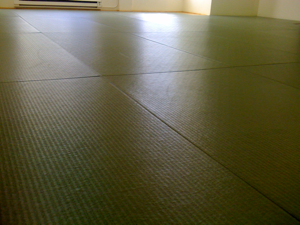 One year comes to an end, another begins.
We spent a portion of a year-end afternoon washing the mats at Toronto Kenjutsu. It was a good chance to reflect on cleanliness and renewal in a dark time of the year.
Miyamoto Musashi warns us against spending too much time keeping everything looking good:
"Do not overvalue the things you have."
"Do not become obsessed with having splendid weapons."
And martial arts tales are full of disreputable characters in grubby robes who turn out to be great masters.
And yet, cleaning and maintaining my space and possessions helps me to clean and maintain my mind. Scrubbing the mats, restoring their shine and luster, helps me to come to the dojo with my mind clear and unclouded. Not to mention that a couple of hours in physical labour with good friends is a fine way to spend an afternoon.
And a fine way to look back on 2010 with thankfulness. We were invited to demonstrate at Haru Matsuri at the Japanese Canadian Cultural Center, a great honour for us. Our practice expanded to two classes a week, and is still going strong. We traveled to Sherbrooke to study with Sugino Sensei. And Såzen Sensei came out for a wonderful weekend seminar that students here are still talking about. New students joined, and our little community has grown over the year. 2010 was very exciting. We wrapped up the year with a bonenkai party at Jigan Dojo, a great chance to visit with other Katori Shinto Ryu practitioners around Southern Ontario.
This past year had many great moments for Toronto Kenjutsu. Now that our mats are clean and shiny, we look forward to 2011 in anticipation of many more!
Labels: Swordfighting
Saturday, August 07, 2010
The Principle
posted by barsoomcore
 The most important truths in life are few, and yet so hard to set down in words. This is why literature endures, century after century. Each generation, each society, has to find new ways of expressing the same truths. There are many paths to learning these truths -- literature is one that has long held value to me. Likewise, swordsmanship. There are deep truths buried in the practice of Katori Shinto Ryu -- but expressing those truths is almost impossible.
We had another lovely visit with Sozen Sensei this past July. A gifted practitioner of Sugino-style Katori Shinto Ryu (he holds a fifth dan in the style), I know Sozen Sensei from Japan, where we practiced together for years at Sugino Dojo. This year, instead of working on one kata after another, Sozen Sensei spoke of the differences between "principle" and "technique", and we spent the weekend exploring the myriad techniques that arise from the principles of Katori Shinto Ryu.
For example, an early move that must be learned is a way by which uketachi (the partner who receives the attack) may receive an incoming cut from kirikomi (the partner who initiates the attack) in such a fashion as to not only deflect the blow, but place his own sword in position for a thrust, forcing kirikomi to retreat. The principle is simple enough -- bring your sword down in time with your opponent's, the tip directed at his center. Actually performing it is not quite so simple, of course.
And even when it is performed correctly, the purpose of such a move is not always obvious. "If both our swords come down together, " a beginning student may wonder, "why does kirikomi retreat and uketachi advance?"
Katori is a style in which what is seen is not always what is happening. The principle -- the action that is practiced over and over again until it becomes automatic -- is not in fact the technique. We practice the principle in the kata, because in the principle is the simplest truth that must be manifested in that moment. Match the timing, keep your tip in the center. You need not know what you are doing at this point, but if you simply practice it again and again, the techniques that are available in this principle will begin to reveal themselves.
Strike the enemy's sword down. Cut the wrist. Lean in and cut the throat. Slide back and thrust in deeply. These objectives, these desired results, are all techniques, and in any given manifestation of the principle, some techniques may be possible and others may not be. It is impossible to know ahead of time which technique ought to be used. But the principle is always valid.
When we practice the kata, at times these techniques may spontaneously arise, and this is fine. But we should never lose sight of the principles themselves, and we should always return ourselves to these simplest truths that Katori reminds us of. Maintain one's center. Understand the lines of engagement. Manage distance.
Katori is so rich, so full of meaning and depth, that I could never imagine mastering every possible technique. Sometimes I discover a new technique that opens doors throughout my mind. This happened in July, watching Sozen Sensei demonstrate some of the techniques hidden inside hakka no tachi. He pointed out the similarity between one movement and the basic cut of Katori Shinto Ryu, maki-uchi, and I had a sudden moment of revelation. I could only laugh as astonishment flooded me. Hidden inside this kata lay the most basic principle of Katori Shinto Ryu, and I now see it everywhere. What was once a matter of technique has become the flowering of a single principle.
It's impossible to share these insights. They cannot truly be transmitted through words, but that makes them more, not less, important. Our words are a technique. A novel is technique. A cut to the wrist is a technique. The wisdom that lies behind the cut, the novel, or the words -- that's principle.
Great instructors like Sozen Sensei are able to reveal the principles to their students, and share in the boundless techniques that arise from them. We are very fortunate to have such people join us in our practice.
Labels: Swordfighting
Sunday, June 13, 2010
The Gift of Attention
posted by barsoomcore
 This past May I was thrilled to be able to attend Sugino Sensei's seminar in Sherbrooke, along with a large number of other Katori Shinto Ryu practitioners from both Ontario and Quebec. For three days we practiced under Sugino Sensei's keen eye. The experience brought back to me thoughts I'd had years ago, about how precious the gift of attention can be.
And while of course receiving such a gift is something to be treasured, in recent days I've been thinking of how simple it can be for any of us to GIVE such a gift as well.
When I face my partner in omote-tachi, or even when practicing kamae (the stances that form the foundation of Katori Shinto Ryu), I am most useful to them when I gift them with my full attention and spirit.
I don't mean that we must put on a fierce face and pretend to be locked in mortal combat, or try to intimidate or startle them. But we can give our attention to them completely, letting nothing distract us from their action. Not only with our eyes, but with our entire being as we perform the kata alertly, attentively, and with a fully present spirit.
It is so rare in our lives that anyone truly pays attention to us. Most people spend every moment consumed with self-reflection, condemning themselves or praising themselves -- usually without nearly as much cause as they imagine -- that they have little energy left over to consider others. Our own lives and worries are so important to us that we ignore the people all around us. This behaviour keeps us from learning, but just as important, it makes it hard for those around us to learn as well. When they do not receive our attention, they do not receive useful feedback that they can use in their efforts to learn and transform.
The practice of Katori offers us an opportunity to put our self-centered concerns aside and engage with others openly, presently. When we perform the katas, if we remain trapped in a selfish inward struggle, we fail to give our partner what they most need at this moment: our attention. This is one of the qualities that makes a teacher like Sugino Sensei so effective -- he sheds himself and focuses entirely on what the student is doing. It is a lesson to myself that regardless of how poor my technique may be, or how tired I am, I can still be of tremendous value to my partner simply by paying careful attention to them.
Photo courtesy of Michel Martin. Sugino Sensei is seated at center. Weins Sensei is seated at right and Mr. Reid (me) is seated at left.
Labels: Swordfighting
Thursday, April 01, 2010
Now Twice the Katori
posted by barsoomcore
 We are happy to announce that Toronto Kenjutsu will be offering classes twice a week starting in April.
Classes will now be held every Monday and every Wednesday at Kokoro Dojo, both nights at 8:30 pm.
We are thrilled that our classes have been popular enough to warrant such a step. This group started in 2008 with very modest objectives -- only to provide a space for interested folks to practice Katori Shinto Ryu in the center of Toronto. With the support of senior instructors like Tong Sensei and Wiens Sensei of Tokumeikan, Toronto Kenjutsu has been able to grow and flourish, providing a chance for students of Japanese swordsmanship to practice this legendary art here in Toronto.
Katori Shinto Ryu is best practiced in small groups -- only through direct communication can this subtle and demanding style be properly learned and understood. Each practitioner must have time to listen and absorb what they are learning. Opening a second evening of practice allows us to maintain our small class size and still accommodate more students.
We are very grateful to the tremendous folks who share our practice with us and have made this possible, and of course to Tong Sensei and Wiens Sensei whose support has made Toronto Kenjutsu possible in the first place. Thank you all, and we look forward to seeing you twice as often!
Labels: Swordfighting
Tuesday, March 02, 2010
Haru Matsuri 2010: A New Year
posted by barsoomcore

Toronto Kenjutsu was pleased to take part in this spring's Haru Matsuri festival at the Japanese Canadian Cultural Centre on March 6, 2010. We performed there under the supervision of the senior Canadian instructors of Katori Shinto Ryu, including Wiens Sensei of Tokumeikan, who is Sugino Sensei's senior student in Canada. Also present was Tong Sensei who teaches at Dragon Fencing Academy in Richmond Hill.
 This was a great honour for our group and we were very excited to be able to bring the practice of Katori Shinto Ryu swordsmanship to the public in this fashion. The Japanese Canadian Cultural Centre has long been a supporter of our art, and we greatly appreciated this opportunity. We have participated in this event for several years now, and it is always a fantastic event. This year was no exception.
Katori Shinto groups from around Toronto came together to practice and to demonstrate traditional Japanese swordsmanship to the many folks attending Haru Matsuri. These events are always a great chance to practice with folks we don't usually practice with, and to learn new techniques and share our observations on this ancient art.
 Working with new people means paying very close attention to each detail. When you always practice with the same folks, you get used to each other's styles and can unconsciously start to anticipate each other's moves. If I start anticipating my partner's moves, then I'm not using my senses to understand what I'm seeing and respond -- I'm interfering in that process with my expectations and my ego. One of the gifts of practicing with new people is that I am stripped of my expectations and am forced to observe, and react solely to what is there, rather than what I expect.
Of course I hope I can act this way even with people I am familiar with, but it's useful to have these chances to put that to the test.
Thanks again to the great people at the Japanese Canadian Cultural Centre and Tokumeikan for allowing us to take part in this event.

Photos by Owen Jacobson.
Labels: Swordfighting
